Showing posts with label #housereef. Show all posts

26.5.16

Creature Feature - Mating Mandarin Fish

Photo by Basil Bohn 
Three bright and iridescent mandarin fish play ring around the rosy in the playground of the TRACC crate reef. These three apparently painted ladies gather each night in a pre-spawning mating ritual in which they display their gleaming blue and orange patterns to a potential mate. Coyly they circle between the holes and loops created by the crates and flutter their fins in a rapid and flirtatious manner.

This ritual is preformed each evening in the fading light of the setting sun. Three to five females will gather in the same place to wait for the male to arrive.  If the male arrives and is large enough to please the ladies, a pair will join together, bellies touching, dorsal fins a-fluttering, and circle upwards to release their sperm and eggs in a tango of a spawning dance.


Shy of bright light, and shy of open spaces, the crevices and holes in the crate reef, give us eager divers a perfect viewing platform. A chance to see the prettiest of fish preform the prettiest of mating rituals and view the ocean stage from the comfort of the house reef and house seats. 

--------------------------------------------------------------

If you want to help with any marine conservation activity, please 
check our website http://tracc.org or e-mail info@tracc-borneo.org 


For more updates on TRACC check out our Facebook, Twitter or Google +


Reef conservation would not be possible without generous financial support from
GEF /SGP for Malaysia who are helping our community activities and coralreefcare.com who generously provided materials to build the new reefs.

If visits to Tracc are not possible then please help with financial support and follow their projects on Facebook.

18.5.16

Creature Feature - The Solar Powered Nudibranch

the solar powered nudibranch
Photo by Basil Bohn
A dash of divers descend down to shallow depths – word has spread that two solar powered nudibranch’s mating have been spotted on the house reef. Incredible creatures who receive the majority of their energy from the sun, the solar powered nudibranch harvests zooxanthellae algae from the soft coral upon which it sometimes feeds. In a fortunate feat of nature, a symbiotic relationship ensues. The photosynthetic zooxanthellae lives safely in the Solar Powered’s digestive system, in turn providing its host with energy from the sun. The long, flat, wide, and translucent leaf like cerata stemming from the nudibranch’s body are veined with exposed digestive system showing a speckling of zooxanthellae beneath a thin layer of translucent skin. The exposed zooxanthellea allow the solar powered nudibranch to receive the energy of the sun and give the solar powered a resemblance of a living moving flower.

The mating solar powered pair rest in the shadows of a TRACC built artificial reef (a teepee); reproduction organs planted in each other at opposite ends to form a circle of gently intertwined bodies in a fanciful mess of softly glowing cerata. They will stay in this circular act of creation until fertilized, laying up to 1 million eggs in a rose patterned spiral somewhere along the reef crest, giving life to a new generation of naturally fantastical creatures.


Nudi = naked, branch = gills, appropriate Latin for creatures making love in the oceanic sun.


--------------------------------------------------------------

If you want to help with any marine conservation activity, please 
check our website http://tracc.org or e-mail info@tracc-borneo.org 


For more updates on TRACC check out our Facebook, Twitter or Google +


Reef conservation would not be possible without generous financial support from
GEF /SGP for Malaysia who are helping our community activities and coralreefcare.com who generously provided materials to build the new reefs.

If visits to Tracc are not possible then please help with financial support and follow their projects on Facebook.

6.5.16

Lobsters Release on the House Reef

Basil, Tom & Alana with the Lobsters
Releasing lobsters is a surprisingly slippery process. They squirm, wiggle, and slide from the grasp of the hand. But before the lobsters can be released onto TRACC’s House Reef, the lobsters must make it to Pom Pom Island – wrapped in newspaper, placed on ice, and snuggled into a cooler.

When the body temperature of a lobster drops the metabolism and heart rate slows, allowing lobsters to survive for 2-3 hours in a significantly cooled state and induces a kind of hibernation, which reduces the stress caused by transportation. When they arrive on Pom Pom we unload the cooler from the boat and wade into the shallows to unwrap the newspaper parcels of lobsters. They emerge from they cold in an unexpectedly alert state and flail in our grasp, legs and antennae gesticulating rapidly. As quickly as possible we place them in the wicker baskets to be taken deeper. Yet, the
Lark & Tom Prepped to Release 
especially fidgety ones escape from our grasp and Tom must mission to retrieve them from the shallows.

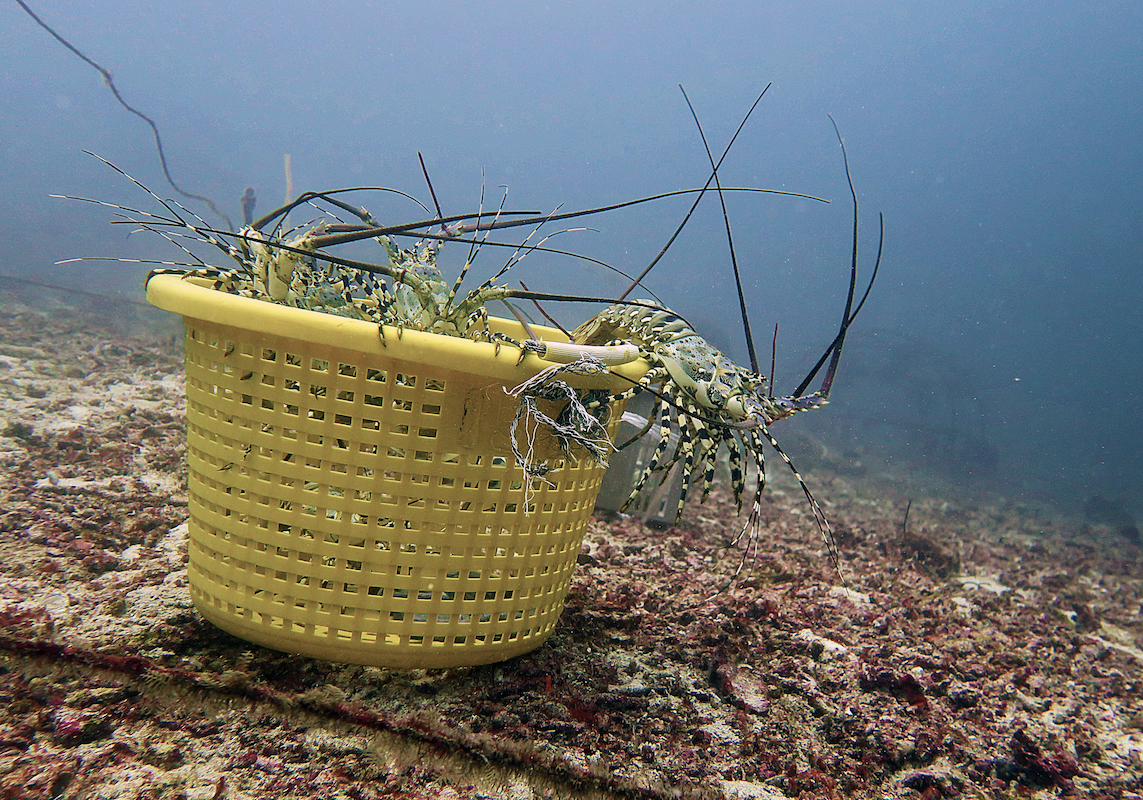
Next, we don our scuba gear and form buddy pairs to bring the basket’s full of lobsters to what we hope will be their new home, carefully we place the baskets on the ocean floor near our newly crafted and placed artificial reef of a “lobster house” and tires. Lobster baskets safely placed we wait and watch. The lobsters test their new environment, peeking over the edge and testing the water with their antennae before clambering out of their baskets to explore the crevices of the tires and lobster houses as their new home. 

Lobster Basket
Over the next few days the lobsters disperse across the reef, sometimes spotted by eager TRACC divers. And sometimes, to entice the lobsters to make a permanent home, Tom goes back down to lay little sausages down by the tires and houses.


TRACC hopes that by releasing the lobsters into our house reef, we not only add biodiversity and beauty to the reef, but also balance our ecosystem. In addition to hunting for urchins and clams, the lobsters scavenge and feast on detritus. Playing as essential role in cleaning the reef and keeping it disease free.


--------------------------------------------------------------

If you want to help with any marine conservation activity, please 
check our website http://tracc.org or e-mail info@tracc-borneo.org 


For more updates on TRACC check out our Facebook, Twitter or Google +


Reef conservation would not be possible without generous financial support from
GEF /SGP for Malaysia who are helping our community activities and coralreefcare.com who generously provided materials to build the new reefs.

If visits to TRACC are not possible then please help with financial support and follow their projects on Facebook.

11.4.16

Mating Rituals of the Many Armed Mollusca - The Day Octopus

Photo Basil Bohn
15 meters down below the TRACC jetty a coquettish female day octopus waits. She is curled into the crevice of a tire with wide doe eyes and domed head peaking above the tire rim. About 4 meters away her male counterpart shyly waits by a patch of coral, peaking his head towards her in a cautious manner, seemingly unsure of how to approach his waiting mate. His caution is justified; sometimes his bigger stronger hungrier counterpart will consume her mate in a cannibalistic fashion. Yet, soon his courage blooms and he sidles towards the tire and his halfway hidden mate in a distinguished waltz. As he dances over he flashes the fanciest of his colors in swaying patterns of black tie octopus attire. Upon arrival, he seemingly scopes out the scene - perhaps he is assessing the potential danger of his promiscuous urges? He crafts his body into the physiology of a pyramid and peeks over the rim, as if asking if he is allowed to enter the domain of his soon to be mate, before gliding over the barrier of the tire to cautiously position himself opposite of her, equally hidden in the tires empty inner crevice.

This manly day octopus is semi-prepared for the potential danger of his procreative urge, he is equipped with an extra long reproductive arm called the hectocotylus complete with sperm packet attached to the tip. Once, twice, three times, in a gesture of gentlemanly grace he cautiously offers his hectocotylus and then withdraws. Still, his mate waits upon his advances, sometimes in a flirtatious or perhaps predatory manner she gently sways and shows the inside of her tentacle arms.


In a final chivalrous procreant gesture and gift, he rolls his hectocotylus around the inside of the empty tire tube to touch his female equivalent. To complete the act he must carefully and cautiously insert this tentacle into the most intimate of places in his mate – through the siphon behind her eyes and into the ovaries located at the tip or her head. It appears as an intimate hand holding between two mollusced lovers shyly meeting for the first time. Yet, this seemingly intimate gesture is tarnished by the knowledge that this specialized reproductive arm; the hectocotylus is a means of evolutionary self-defense. The sex life of a male octopus is fraught with danger; get too close to a lady lover and maybe you’ll get eaten.

--------------------------------------------------------------

If you want to help with any marine conservation activity, please 
check our website http://tracc.org or e-mail info@tracc-borneo.org 


For more updates on TRACC check out our Facebook, Twitter or Google +


Reef conservation would not be possible without generous financial support from
GEF /SGP for Malaysia who are helping our community activities and coralreefcare.com who generously provided materials to build the new reefs.

If visits to Tracc are not possible then please help with financial support and follow their projects on Facebook.