Pom Pom Island, is a jewel of a white sand island in the Celebes Sea. Nestled next to Borneo island in the NE Semporna islands.
Warm clear water, great diving and snorkelling. a tropical paradise
Great place for marine conservation - sharks - turtles or coral
Come visit TRACC and make a difference with your next trip.

Showing posts with label Semporna. Show all posts
Showing posts with label Semporna. Show all posts
5.9.16
16.9.15
Volunteering AND Making A Difference
 |
| Counting Corals underwater |
At Pom Pom island, overfishing and fish bombing activities
have caused unstable slopes and damaged reefs. If you ever have the chance to
snorkel around Pom Pom, you’ll realize how there are many fragments of corals
on the bottom. These corals will eventually die if they can’t find a spot to
hold on to and grow. Here is where TRACC makes a difference. TRACC strives to
produce around 1000 -2000 coral biscuits (from scratch) every year – some of
which have now grown into big corals and help fishes!
When I first heard the term “coral biscuits”, I thought it
was a food? (Maybe I was hungry when I had that thought). But when I took my
first dive and saw a couple of them on the sea bed, I was amazed. There were
massive amounts of coral biscuits around TRACC’s nursery points. Before you go
finding for them at Pom Pom, beware that they are actually very fragile. A
slight impact could break them! Imagine how I felt when illegal fisherman
bombed a huge site filled with coral biscuits?!

I’ve been long enough at TRACC to call it my second home. It
has all kinds of fishes, artificial corals, and cool people. I’m reflecting
back on my experience at TRACC and it has been nothing but great! It’s one of
those rare places where people truly feel welcomed even though that’s your
first time stepping into TRACC. I’ve been inspired in some sense to further
TRACC’s mission to preserve the ocean and coral reefs. Maybe I’ll get to have
my own center one day?
If you’re interested in coral reef conservation, TRACC would
be a good place to do this. Not only do you get hands on experience on it but
also get to be a part of a community where you learn about conservation. I’m
not just saying that I really mean it!
To volunteer and help with coral reef restoration
For more information, please check our website or e-mail info@tracc-borneo.org
The main website is at http://tracc-borneo.org
Check out our posts on our activities
on fb tracc.borneo
on twitter tracc_borneo
on google + tracc
For more information, please check our website or e-mail info@tracc-borneo.org
The main website is at http://tracc-borneo.org
Check out our posts on our activities
on fb tracc.borneo
on twitter tracc_borneo
on google + tracc
or simply #tracc or #traccblog on Google, Facebook, twitter or instagram
Reflection: Building Artificial Reefs
 |
| Step Reefs |
My experience at TRACC revolved around building step reefs which is a type of artificial reefs. Step reefs are placed on the slope of the ocean bed to serve as wave barrier.( If you're confused don't worry! I was too when I first started. But you'll pick up things easily at TRACC)
It's funny when I first heard the term "step reef". I thought it was a square reefs just like steps of a stairs. I had a lot of questions playing through my mind. Was it big? Was it small? Was it square? Only later did I realize it was simply a square with glass bottles attached to it. If I had the time, I would have spent it trying to play around with the materials used in building the step reef such as steel or twigs. (Maybe I'll come back next year!)
Making a step reef is not as complicated as it seems. The main material used are cements and bottles. You mix the cements on a crate and add the bottles to it. It's simple! Of course, it's going to take some hardwork such as working in the sun and able to dive a couple of times a day to plant the reefs underwater. Sometimes, I get exhausted but then I realize how much impact I get to make to the environment and that motivates me a lot.
 |
| Hardworking :) |
TRACC provides training and a place to make your artificial reefs. In fact, I wouldn't have even learned most of the things I have without training. My experience at TRACC will help my goal to pursue my education in marine biology which is something I'm deeply passionate about. More than that, I gained valuable experience as an intern here - how often does anyone get to say they've had hands on experience building coral reefs!
For more information, please check our website or e-mail info@tracc-borneo.org
The main website is at http://tracc-borneo.org
Check out our posts on our activities
on fb tracc.borneo
on twitter tracc_borneo
on google + tracc
or simply #tracc or #traccblog on Google, Facebook, twitter or instagram
14.7.15
Malaysian Interns 2015
Our 2015 Malaysian Interns are finally here!

Malaysian Universities require their students to do twelve weeks of Industrial Training as part of their degree course. This year our lucky interns are coming to us from both UMT and UMS and have backgrounds in Marine Science or Conservation Biology. They successfully beat the rush back in December and were undeterred by the challenging application process; Allen, Martinus, Nadia & Shaakirah have finally made it all the way to an exciting internship with TRACC on Pom Pom, Sabah, Malaysia.
They will learn to scuba dive and (once they get past blowing bubble rings for hours) how to get to work underwater. Cement mixing, concrete lifting and lowering, reef rebuilding and coral transferring are all part of the days work at TRACC. This is part of our major restoration work where we stop the decimated rubble reef from moving and plant healthy baby corals in stable conditions. These in turn grow, stabilize the rubble further and provide critical habitat for all the other denizens of the reef.

On top of this, they will be undertaking research rotations with our resident scientists on the long term projects TRACC has running. These include fish, coral and invertebrate identification to species (there are over 300 species of fish alone!). The coral garden identification and mapping project (the coral id book comes in 3 volumes!). Soft coral stabilization of steep, mobile, rubble substrates ("Perhaps we can use soft coral to "stitch" the reef back together so that it stops moving enough for us to replant it".). Turtle daily migration patterns (Seriously, where does George go every afternoon?).
Finally, they will be mixing with people from different places, ages, backgrounds, opinions and experiences and discussing and debating all the marine science, conservation, ecology, anthropology, sociology and politics that affect the marine environment. The critical thing that unites everyone at TRACC is a love of the ocean, a passion to preserve what we have and the dedication to restore what has been damaged.
Allen, Martinus, Nadia & Shaakirah have a unique opportunity to witness the problems and take part in the solutions for themselves before graduating as enthusiastic Malaysian Scientists.
 Good Luck Guys!
For more information, please check our website or e-mail info@tracc-borneo.org
The main website is at http://tracc-borneo.org
Check out our posts on our activities
on fb tracc.borneo
on twitter tracc_borneo
on google + tracc

Malaysian Universities require their students to do twelve weeks of Industrial Training as part of their degree course. This year our lucky interns are coming to us from both UMT and UMS and have backgrounds in Marine Science or Conservation Biology. They successfully beat the rush back in December and were undeterred by the challenging application process; Allen, Martinus, Nadia & Shaakirah have finally made it all the way to an exciting internship with TRACC on Pom Pom, Sabah, Malaysia.
They will learn to scuba dive and (once they get past blowing bubble rings for hours) how to get to work underwater. Cement mixing, concrete lifting and lowering, reef rebuilding and coral transferring are all part of the days work at TRACC. This is part of our major restoration work where we stop the decimated rubble reef from moving and plant healthy baby corals in stable conditions. These in turn grow, stabilize the rubble further and provide critical habitat for all the other denizens of the reef.

On top of this, they will be undertaking research rotations with our resident scientists on the long term projects TRACC has running. These include fish, coral and invertebrate identification to species (there are over 300 species of fish alone!). The coral garden identification and mapping project (the coral id book comes in 3 volumes!). Soft coral stabilization of steep, mobile, rubble substrates ("Perhaps we can use soft coral to "stitch" the reef back together so that it stops moving enough for us to replant it".). Turtle daily migration patterns (Seriously, where does George go every afternoon?).
Finally, they will be mixing with people from different places, ages, backgrounds, opinions and experiences and discussing and debating all the marine science, conservation, ecology, anthropology, sociology and politics that affect the marine environment. The critical thing that unites everyone at TRACC is a love of the ocean, a passion to preserve what we have and the dedication to restore what has been damaged.
Allen, Martinus, Nadia & Shaakirah have a unique opportunity to witness the problems and take part in the solutions for themselves before graduating as enthusiastic Malaysian Scientists.
 Good Luck Guys!
For more information, please check our website or e-mail info@tracc-borneo.org
The main website is at http://tracc-borneo.org
Check out our posts on our activities
on fb tracc.borneo
on twitter tracc_borneo
on google + tracc
or simply #tracc or #traccblog on Google, Facebook, twitter or instagram
22.5.15
Rescue diver, search pattern exercise
Today we had the search pattern exercise on land for our three rescue diver students.
Tomorrow we will have a rescue scenario underwater, photos of that to follow, so stay tuned...

More info about learning to dive or volunteering to help save the ocean with TRACC in Malaysia - Turtle Snorkellers - Divers


Tomorrow we will have a rescue scenario underwater, photos of that to follow, so stay tuned...

More info about learning to dive or volunteering to help save the ocean with TRACC in Malaysia - Turtle Snorkellers - Divers


20.5.15
Underwater art - The shark - 1
Dino and the shark, soon to be seen in the ocean (the shark that is, not Dino)
Imagine how this structure will look in a while with an abundant life of corals on it. It'll be the coral shark.

17.4.15
Pom Pom revisited
 |
| bottle nurseries |
Here's the before pictures..... keep following our blog for the after-pictures coming soon :)
We also have bottle nurseries ready for deployment creating new habitat for marine life and to act as buffering from storms.
The view however doesn't need any fixing, it's perfectly amazing just as it is.
In a month the camp will be better than this :-)
More info about volunteering with TRACC in Malaysia - Turtle Snorkellers - Divers
 |
| dive shop |
 |
| bottle nurseries |
 |
| Camp area |
 |
| Kitchen |
 |
| View |
 |
| View |
14.4.15
WE SAW DOLPHINS NEAR THE TIP OF BORNEO!!!
It was quiet
during our return trip from Light House. The weather was hot, but the sea was
wavy and the water was cold. Everyone was tired after the harsh condition of
the routine work dive. Max was our boatman that day. Even this humorous guy was
not as chatty as he usually was.
I was deep in my own thought when
the boat suddenly came into a halt. “Something’s wrong?” Max never stopped the
boat without warning unless there’s a problem with the engine. “Something
jumped out from the sea surface…seems like a dolphin.”
I was astonished. “Really!? Dolphin? Where??” Everybody in the boat was
stirred upon hearing the word DOLPHIN.
“Right----over there,” Max replied with his usual comical manner,
“slightly to your left.” We brought ourselves to the side of the boat and gazed
towards the direction Max pointed at. Someone fetched the camera and started
videoing.
 One…two…swoosh! It was within seconds when another dolphin jumped out,
right in front of our eyes. “A dolphin!” “DolphinSS!” There was more than just
one. “Woohoo!” “Did you get it on the camera!?” We were all excited. “Quick!
Quick! Snorkel!! Fins!!!” “Jump jump jump jump!” We frantically put on our
equipment and jumped off the boat, hoping to get closer and swim alongside the
dolphins. But no, of course it didn’t happen, we scared them away instead XD.
One…two…swoosh! It was within seconds when another dolphin jumped out,
right in front of our eyes. “A dolphin!” “DolphinSS!” There was more than just
one. “Woohoo!” “Did you get it on the camera!?” We were all excited. “Quick!
Quick! Snorkel!! Fins!!!” “Jump jump jump jump!” We frantically put on our
equipment and jumped off the boat, hoping to get closer and swim alongside the
dolphins. But no, of course it didn’t happen, we scared them away instead XD.
We climbed back into the boat and Max brought the boat towards the school of dolphins. We were literally chasing after them. The dolphins seemed to realize our approach and jumped out of the sea a couple of times. I fancy they were greeting us in dolphin’s custom, haha.
We followed the dolphins for some time, and managed to get close enough
to tape some videos to show our friends before heading back
to camp. It was totally awesome. Now I have another thing to brag to my friends
about my stay with TRACC.
--Emily--
20.11.13
Dolphins around Pom Pom
%2B(800x569).jpg "Dolphins at Pom Pom Island")
Dolphins and other marine mammals are not common in the Semporna area of Sabah, Malaysia. Even on Mabul and Sipadan (world famous dive sites 70km from us) there are very few marine mammals seen.
More info about volunteering with TRACC in Malaysia - Turtle Snorkellers - Divers
%2B(1024x239).jpg)
15.11.13
Diving the N. Tip of Pom Pom island
The north tip of Pom
Pom island (Semporna, Sabah, Malaysia) is a wall dive with the best
wall starting at 30m. The reef crest at the north end of the Pom Pom
reef wall has a large flat plateau The current splits at this point
and there is a choice to swim either W around the N tip wall or East
around the Fleavie wall.
The boat ties to the
mooring and we kit up. Quick check of the current direction and last
minute gear checks and we are off.
Backwards roll dive
entry into 3-4m of water next to a large mushroom shaped bommie and a
large area covered with bottle reefs planted by TRACC. The reef
slope is covered with rubble and macrolife such as nudibranchs and
frogfish can be found. Our dive is to go deep, so we pass rapidly
across this shallow dive site down to 20m. A quick ok and then we
curve off to the left and down a gully. The visibility is awesome at
least 40 and maybe 50m and the wall looms up some way in front. The
currrent has started to pick up and there are increasing numbers of
small schooling fish. Big black coral bushes (“I must remember
to ask the TRACC scientists why black !!! coral is actually red or
white or green”) and a school of bannerfish mark mark the end
of the gulley. I learn later that in 2012 when TRACC first surveyed
the island of Pom pom, there were 3 of these schooling bannerfish.
Now they are impossible to count. Everything is so approachable,
the current is quite strong and all the fish are facing the current
looking for food and ignoring the divers. A shoal of bait fish swims
past and the big fish follow, 2 giant trevally, a small group of no
idea (rainbow runners – id later from the photos) and a larger
school of the bluefin trevally. I stop on the corner of the wall and
try to get a good photo of the red tooth triggers when the school of
big eye trevally swims past. Not worried by the 4 or was it 5
species of trevally, the small fish suddenly scatter. Swimming along
the wall is a huge dogtooth tuna. It glides past a few metres away
and then all the small fish return. Beep Beep, all to soon the
computer says go up and then the best part of the dive started.
As we slowly ascend
cross the plateau we see one or two then 5 or more, green turtles
resting. Each bommie has at least one large female turtle and in the
water column, a male is cruising looking for action. The females are
not timid, they generally ignore divers, one female lifts off slowly
and the nearest male cruises alongside. I learn later that mating
was finished a few weeks ago, but the males are still searching for a
willing partner. The cameras are clicking and I can see my buddy
gesturing for me to swim into the right place to get that fantastic
picture of me and a turtle drifting across the reef.
We gradually ascend to
9m and the seabed is a flat gentle slope of broken rubble. There
clearly was a great reef here once but the blast fishing has
decimated the fragile coral and it looks like the gravel when a road
is being built. The vis is definitely 40m and I can see rubble in
all directions, flat and featureless. But ahead past the dive master
is a cloud of small fish. I look closer and they are living on a
bottle reef. It is made from a ring of glass bottles embedded in
cement and then the centre of the ring was plastic bottles. The
whole structure is covered with coral and spomges and only a few
bottle tops can still be seen. The fish definitely like it - there
is a sabre tooth blenny hidden in the neck of lots of bottles and
many many small fish. It is easy to see that the artificial reefs
built by TRACC volunteers are making a huge difference to reef
recovery..
Floating up into the
shallows, there are more TRACC reefs, the ribbon reef snakes across
the reef crest and is a highway for butterfly fish, blue devil
damsels, anthias and many others. With successful artificial reefs
like these I am fired up and will definitely be making reefs this
afternoon.
11.6.12
Coconut Crab Surprise
 |
| Coconut crab on Pom Pom Island |
After completing four marvellous dives and watching the sun set with a cup of tea in hand, it was time to make a quick change of clothes before dinner. While near my tent sanctuary I caught a glimpse of coconut crab walking proudly across the grass. Instantly I noticed this crab's unique shell and knew it must be photographed. I then let him on his way as I was lured back towards the resort by the smell of Malaysian cooking.

At the dinner table I showed the infamous Steve Oakley the pictured of the crab I named MacGyver. Steve's excitement surprised me, as it seems hard to surprise a man with a such a large knowledge of marine life. But, it just so happens coconut crabs were thought to be absent from the island of Pom Pom, and these two pictures proved that theory incorrect. The lesson here is to always keep your eyes open, as every moment in nature has potential to be a discovery.
The next task is to strategically place small bits of food around the island in hopes of attracting more coconut crabs for surveying and tracking. Results to follow!
Janaye Williamson
More information on volunteering with TRACC - Facebook page - pom pom island biodiversity - Marine biology courses -
2.5.12
Pom Pom Turtle island
Pom Pom should have been called turtle island, from the
moment I arrived I saw turtle after turtle swimming around in the ocean. I got
so excited at seeing these beautiful creatures in the flesh that I couldn’t help
but swim after each one, tiring myself out within a short space of time of racing
up and down the reef! The turtles would either be resting on coral or just
merrily swimming around, some were 1m plus and some smaller but each one was as
graceful as the next and just as exciting to see.

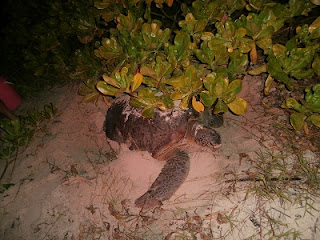 On my fifth night here I got
to see a turtle nesting!!! It was an amazing experience a huge 1m female laid
101 eggs and I got to share in this beautiful moment.
On my fifth night here I got
to see a turtle nesting!!! It was an amazing experience a huge 1m female laid
101 eggs and I got to share in this beautiful moment.
Steve was briefing the guests on turtle ‘antics’ (he is pretty much a walking encyclopaedia when it comes to marine life) and I was getting slowly more and more annoyed with my camera as it was brand new and I hadn’t yet worked out how to use the night vision and film settings. I was silently going mental at the fact that I couldn’t capture this rare moment, but luckily managed to get a few good shots in the end.
More information on volunteering with TRACC - Facebook page - pom pom island biodiversity - Marine biology courses -


Steve was briefing the guests on turtle ‘antics’ (he is pretty much a walking encyclopaedia when it comes to marine life) and I was getting slowly more and more annoyed with my camera as it was brand new and I hadn’t yet worked out how to use the night vision and film settings. I was silently going mental at the fact that I couldn’t capture this rare moment, but luckily managed to get a few good shots in the end.
More information on volunteering with TRACC - Facebook page - pom pom island biodiversity - Marine biology courses -
Masters Project On Pom Pom Island
Pom Pom Island, there is only one word to describe it....paradise. I arrived
here on Pom Pom on the 18th of April
2012 and literally felt like I had stepped into paradise. The view of the
island from the boat was just breathtaking, turquoise water, white sands. I was
overwhelmed with excitement at the fact that I was going to stay in this beautiful
place for my masters project! As I got off the boat I was greeted so nicely by
all the staff and instantly felt at home. Something told me this was going to
be a good three months.
My time here will be devoted to conducting fieldwork for my Msc project with Professor Steve Oakley as my mentor, on the soft coral Parerythropodium fulvum fulvum. Yes, I know it is a mouthful hence Steve named it ‘the yellow triffid’ due to its fast growth rate and ability to grow over a lot of coral and substrate. I will be looking specifically at this growth rate and how it is affected by depth, current and location which is something that has not been looked at before with regards to this species thus will be answering numerous ecological and biological questions with regards to this species.
After growing the yellow
triffid in the coral nursery at depths of 3-5m (we went to Pandanan Island to
collect a surplus of yellow triffid and then placed fragments of it on 15×15cm concrete
blocks and letting it grow for two weeks) we plan to go to 6 different locations (regional
island reefs varying by current intensity and ecology) and place the coral at
varying depths of 5,10,15,20,25 m along a transect and recording the growth
rate at 2 week intervals. This will be done by photographing each block of
yellow triffid and working out the increase in horizontal growth using a design
software programme called AutoCAD. This is easily feasible due to the fast
growth rates observed by this species.
If I have time I will try and also look at what might be predating on the yellow triffid as it has been observed that colonies of yellow triffid in the wild only increase upto a certain size. Thus something very obsecure and not obvious has to be predating on it, as it has yet to be seen. I would also like to look at competition of yellow triffid with numerous aggressive hard corals as I have observed it growing over only some species of hard coral in the wild and it has not been able to grow over other species. Determination of these specific species would increase knowledge of this species of soft coral has not been studied in great depth.
 |
| The beautiful island of Pom Pom |
My time here will be devoted to conducting fieldwork for my Msc project with Professor Steve Oakley as my mentor, on the soft coral Parerythropodium fulvum fulvum. Yes, I know it is a mouthful hence Steve named it ‘the yellow triffid’ due to its fast growth rate and ability to grow over a lot of coral and substrate. I will be looking specifically at this growth rate and how it is affected by depth, current and location which is something that has not been looked at before with regards to this species thus will be answering numerous ecological and biological questions with regards to this species.
 |
| Parerythropodium fulvum fulvum. ‘the yellow triffid’ |
If I have time I will try and also look at what might be predating on the yellow triffid as it has been observed that colonies of yellow triffid in the wild only increase upto a certain size. Thus something very obsecure and not obvious has to be predating on it, as it has yet to be seen. I would also like to look at competition of yellow triffid with numerous aggressive hard corals as I have observed it growing over only some species of hard coral in the wild and it has not been able to grow over other species. Determination of these specific species would increase knowledge of this species of soft coral has not been studied in great depth.
More information on volunteering with TRACC - Facebook page - pom pom island biodiversity - Marine biology courses -
9.4.12
The pom pom coral nursery in April 2012

These pictures show the new hard coral blocks on the reef crest in early April 2012. Look at the empty rubble areas between the corals we planted.
The corals are doing well apart from occasional crown of thorns starfish that try to eat the coral fragments.


26.3.12
Getting to Pom Pom
To get to Semporna from KK we had to take a bus, then boat over to Pom Pom island, overall the journey took 12 hours all of which were incredibly exhausting. We got to the bus station at around 6:00pm which was subsequently followed by 1and a half hours outside a police station. Some would blame this on just being paranoid tourists, but I would say we were just coincidently there. The bus had a puncture so that had to be fixed before we could leave. The 8 hour bus ride could be compared to Dantes 9 circles of hell. It would be described as less then pleasant and hardly a wink of sleep was gained by any person on the bus apart from myself, as I am really awesome.
There are few things in life that I am thankful for but blankets are certainly one of them. The blasting air con certainly did not contribute to the joy of the bus ride, but thankfully I was able to actually to get to sleep considering my friend allowed me to conveniently place my legs over her whilst I slept. However some may argue that I am able to get to sleep just about anywhere because my slumber lasted throughout an hour after getting off the bus, sitting in the TRACC office, and then proceeded to continue throughout the boat trip over to Pom Pom island.
It took a while to pack all of our equipment and luggage and Guido was surprised at how many bags we had. There was a moment of worry about if we would have to make two trips or if the boat would be able to sustain the amount of luggage we had, including the weight of everyone who needed to travel over. After what seemed like ages of planning and rearranging, we finally set off with all the bags and all the people on board.
Making our way to the island, there was yet another brief moment of panic when the boat stopped, but luckily that was just a false alarm, as there was only a small amount of plastic that covered the engine for a second, the bag then luckily untangled itself and the boat continued sailing through the waves.
Overall the boat journey was an hour, maybe more, quite hard to tell actually because I did end up sleeping throughout the whole journey with my friend lying on my shoulder. Could have been 30 minutes could have been an hour and a half. Only after we got to the island did I find out that there were photos taken of me as I slept. Very unfortunate that they would not be deleted either.
We arrived at the island at about 8:45 and were all completely drained of energy by the end of the whole trip. We all really just wanted to sleep. Despite our best efforts to try and take a nap, we were then instructed to unload all of the bags and equipment from the boat and load it on to a massive canvas that we had placed on the sand. We decided to try and make a productive chain so that we could get the job done quicker and then rest. Overall the journey was hard, but fingers crossed its well worth it.
Jackie Mac
More Info on volunteering with TRACC
More Photos on TRACC facebook
 |
| The buses are modern and comfortable. |
There are few things in life that I am thankful for but blankets are certainly one of them. The blasting air con certainly did not contribute to the joy of the bus ride, but thankfully I was able to actually to get to sleep considering my friend allowed me to conveniently place my legs over her whilst I slept. However some may argue that I am able to get to sleep just about anywhere because my slumber lasted throughout an hour after getting off the bus, sitting in the TRACC office, and then proceeded to continue throughout the boat trip over to Pom Pom island.
 |
| Sleeping in the office |
Making our way to the island, there was yet another brief moment of panic when the boat stopped, but luckily that was just a false alarm, as there was only a small amount of plastic that covered the engine for a second, the bag then luckily untangled itself and the boat continued sailing through the waves.
 |
| Sleeping on the boat |
We arrived at the island at about 8:45 and were all completely drained of energy by the end of the whole trip. We all really just wanted to sleep. Despite our best efforts to try and take a nap, we were then instructed to unload all of the bags and equipment from the boat and load it on to a massive canvas that we had placed on the sand. We decided to try and make a productive chain so that we could get the job done quicker and then rest. Overall the journey was hard, but fingers crossed its well worth it.
Jackie Mac
More Info on volunteering with TRACC
More Photos on TRACC facebook
Subscribe to:
Posts (Atom)