Pom Pom Island, is a jewel of a white sand island in the Celebes Sea. Nestled next to Borneo island in the NE Semporna islands.
Warm clear water, great diving and snorkelling. a tropical paradise
Great place for marine conservation - sharks - turtles or coral
Come visit TRACC and make a difference with your next trip.

Showing posts with label snorkell. Show all posts
Showing posts with label snorkell. Show all posts
5.9.16
16.10.15
A typical day as a turtle volunteer
Since 2011, TRACC volunteers have been working to protect green and hawksbill
turtles in the NE Semporna islands from our base on Pom Pom Island that is one of the most important
hawksbill nesting sites in the Celebes sea. Hawksbill and Green nesting was nearly wiped out by decades of extensive harvesting of eggs for food and shell for the
international tortoiseshell trade. However, TRACC's sustained presence has
greatly reduced poaching and other threats, and fewer nests are disturbed each season.
The tides largely determine how the day of a turtle volunteer will be
spent but a standard day will include at least 2 snorkels at high and
low tide which are around 1km long and we use any current to make the
swim as easy as possible. On this snorkel you will look for green and
hawksbill turtles and will keep a tally of how many males and females
you see and what size they are. The TRACC science staff will teach about identifying turtle sex and species.
Between snorkel surveys there will be opportunities to help construct artificial reef, to learn to identify the numerous different fish on the Pom Pom island, take part in beach clean ups to keep the beach clean and clear for the nesting turtles or you can relax on the beach and have some fun snorkels.
Once the sun sets hourly night patrols of the beach commence to look for turtle tracks and nesting turtles, these can continue through the night depending on tides and season. Sitting on a desert island beach listening to the lapping of gentle waves and watching shooting stars is part of a turtle volunteers job. On the beach behind the turtle continues to crash through the undergrowth as it looks for a suitable nesting site. After suitable training you will be conducting impromptu lectures to teach the tourists about turtle biology and conservation.

If a nesting turtle is discovered you will be trained to carefully remove her eggs from her nest as she lays them and will learn how to recreate her nest to transplant the eggs in the islands secure hatchery. There is no sensation in the world that matches holding a freshly laid turtle egg in your hand.
The other great experience is for those lucky enough to be on the island on a hatching day - we release hatchlings at sunset and they scramble down the beach and then get their swimming going as they swim off at high speed towards deepwater.
We are very lucky at TRACC on Pom Pom Island that there are no significant predators of turtle eggs or hatchlings. Nothing except humans digs up nests and we have a hatchery to eliminate egg poaching. Forget the National Geographic images - you won't see lots of hatchlings die at the water edge from birds or crabs. There is almost no mortality of hatchlings on the island and since they are well dispersed they have a great chance of avoiding any reef based fish on their way to the safety of open water.

The TRACC turtle volunteers have released nearly 10,000 hatchlings over the past 4 years. With an estimated global adult population of green turtles between 85,000 and 90,000 nesting females our tiny island is producing a significant number of these severely endangered species.
Reviews about TRACC
More about Turtles - Booking a Turtle conservation trip
More turtle science - General information on Hawksbill turtles or Green Turtles

 |
| There are turtles in the water all year but the numbers increase in the summer as more nesting females arrive. |
 |
| Many of the NE Semporna islands have nesting turtle populations and TRACC turtle snorkellers help monitor populations by surveying several different islands |
Between snorkel surveys there will be opportunities to help construct artificial reef, to learn to identify the numerous different fish on the Pom Pom island, take part in beach clean ups to keep the beach clean and clear for the nesting turtles or you can relax on the beach and have some fun snorkels.
Once the sun sets hourly night patrols of the beach commence to look for turtle tracks and nesting turtles, these can continue through the night depending on tides and season. Sitting on a desert island beach listening to the lapping of gentle waves and watching shooting stars is part of a turtle volunteers job. On the beach behind the turtle continues to crash through the undergrowth as it looks for a suitable nesting site. After suitable training you will be conducting impromptu lectures to teach the tourists about turtle biology and conservation.

If a nesting turtle is discovered you will be trained to carefully remove her eggs from her nest as she lays them and will learn how to recreate her nest to transplant the eggs in the islands secure hatchery. There is no sensation in the world that matches holding a freshly laid turtle egg in your hand.
The other great experience is for those lucky enough to be on the island on a hatching day - we release hatchlings at sunset and they scramble down the beach and then get their swimming going as they swim off at high speed towards deepwater.
We are very lucky at TRACC on Pom Pom Island that there are no significant predators of turtle eggs or hatchlings. Nothing except humans digs up nests and we have a hatchery to eliminate egg poaching. Forget the National Geographic images - you won't see lots of hatchlings die at the water edge from birds or crabs. There is almost no mortality of hatchlings on the island and since they are well dispersed they have a great chance of avoiding any reef based fish on their way to the safety of open water.
The TRACC turtle volunteers have released nearly 10,000 hatchlings over the past 4 years. With an estimated global adult population of green turtles between 85,000 and 90,000 nesting females our tiny island is producing a significant number of these severely endangered species.
Reviews about TRACC
More about Turtles - Booking a Turtle conservation trip
More turtle science - General information on Hawksbill turtles or Green Turtles

10.8.15
What the Turtle Volunteers have been up to
 About 25% of TRACC volunteers from May-September come to monitor the turtle nesting. It isn't possible to dive all day and walk round the island all night so this program is specifically for people who want to do some conservation without the expense (in either money or energy) of diving and reef restoration. They walk quietly round our lovely little island in the silence of the night and then snorkel peacefully in the heat of the day.
  The turtle volunteers are also conducting in-water turtle surveys to monitor the turtle population and activity around the island. We've found that the green turtles outnumber the hawksbills by 10:1, but that the population dynamic is different. The green turtles are transitory adults; spending their days sleeping and eating in the shallows, mating and nesting. The hawksbill turtles tend to be resident, active juveniles.
 Once the female greens are ready, they haul themselves up the beach and wander round it (often for hours) trying to find the perfect place to lay their precious eggs. We don't have any photos of this because any sort of disturbance at this point will have them beating a hasty retreat. So our turtle volunteers sit in the dark waiting for the girl to be ready.
 Finally, when everything is perfect she settles into a semi-trance and starts to lay her eggs. She lays anywhere from 30-150 eggs depending on her age and how long she's been holding them. Often a female will return to the beach and go through the nesting process two or three times before she's finished for the season.
At this point the volunteers get face down in the sand for the enviable privilege of catching turtle eggs straight out of the mother. The eggs are all collected carefully and transferred to the island hatchery where they are safe from human poachers. There are no natural predators of turtle eggs on the island and if it wasn't for poaching the nests could be safely left in situ to develop naturally.
Although turtles are totally protected species and there are stiff penalties for taking their eggs, the local stateless people have very few economic opportunities. The poaching of turtle eggs is a major source of revenue for them but a major threat to turtle conservation.
All credits to Wirginia Romanowicz-Basiak for the photos.
For more information, please check our website or e-mail info@tracc-borneo.org
The main website is at http://tracc-borneo.org
Check out our posts on our activities
on fb tracc.borneo
on twitter tracc_borneo
on google + tracc
or simply #tracc or #traccblog on Google, Facebook, twitter or instagram
6.6.15
Mapping the house reef
Last week a team went out to map the house reef, I the self proclaimed photographer in training went with them.
I did get some photos of our great team working with the mapping but was also distracted from that by the natural beauty of marine life, what can I say.. diving at Pom Pom is so amazing that you just want to take photos of it all.
I mean who can resist a turtle scratching himself....it is no wonder that the structures that TRACC creates dont always grow in the way we expect. The turtles rearrange things to suit their itches.
More info about learning to dive or volunteering to help save the ocean with TRACC in Malaysia - Turtle Snorkellers - Divers
For more information, about learning to dive or volunteering to help save the ocean with TRACC in Malaysia - Turtle Snorkellers - Divers
please check our website or e-mail info@tracc-borneo.org
The main website is at http://tracc-borneo.org
Check out our posts on our activities
on fb tracc.borneo
on twitter tracc_borneo
on google + tracc
 |
| Don't mind me, I'm just scratching myself |
I mean who can resist a turtle scratching himself....it is no wonder that the structures that TRACC creates dont always grow in the way we expect. The turtles rearrange things to suit their itches.
More info about learning to dive or volunteering to help save the ocean with TRACC in Malaysia - Turtle Snorkellers - Divers
 |
| Jo carrying the heavy crate with sand filled bottles to be used for the mapping |
 |
| Placing the survey line markers gently on the seabed. |
 |
| The 3rd auditorium, our newest addition |
 |
| Jo chilling out after work well done |
 |
| Tom preparing one of the mapping bottles |
please check our website or e-mail info@tracc-borneo.org
The main website is at http://tracc-borneo.org
Check out our posts on our activities
on fb tracc.borneo
on twitter tracc_borneo
on google + tracc
or simply #tracc or #traccblog on Google, Facebook, twitter or instagram
11.6.12
Coconut Crab Surprise
 |
| Coconut crab on Pom Pom Island |
After completing four marvellous dives and watching the sun set with a cup of tea in hand, it was time to make a quick change of clothes before dinner. While near my tent sanctuary I caught a glimpse of coconut crab walking proudly across the grass. Instantly I noticed this crab's unique shell and knew it must be photographed. I then let him on his way as I was lured back towards the resort by the smell of Malaysian cooking.

At the dinner table I showed the infamous Steve Oakley the pictured of the crab I named MacGyver. Steve's excitement surprised me, as it seems hard to surprise a man with a such a large knowledge of marine life. But, it just so happens coconut crabs were thought to be absent from the island of Pom Pom, and these two pictures proved that theory incorrect. The lesson here is to always keep your eyes open, as every moment in nature has potential to be a discovery.
The next task is to strategically place small bits of food around the island in hopes of attracting more coconut crabs for surveying and tracking. Results to follow!
Janaye Williamson
More information on volunteering with TRACC - Facebook page - pom pom island biodiversity - Marine biology courses -
2.5.12
Pom Pom Turtle island
Pom Pom should have been called turtle island, from the
moment I arrived I saw turtle after turtle swimming around in the ocean. I got
so excited at seeing these beautiful creatures in the flesh that I couldn’t help
but swim after each one, tiring myself out within a short space of time of racing
up and down the reef! The turtles would either be resting on coral or just
merrily swimming around, some were 1m plus and some smaller but each one was as
graceful as the next and just as exciting to see.

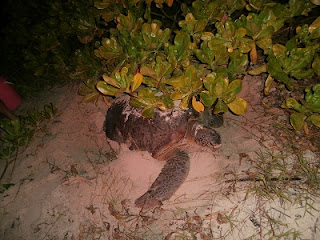 On my fifth night here I got
to see a turtle nesting!!! It was an amazing experience a huge 1m female laid
101 eggs and I got to share in this beautiful moment.
On my fifth night here I got
to see a turtle nesting!!! It was an amazing experience a huge 1m female laid
101 eggs and I got to share in this beautiful moment.
Steve was briefing the guests on turtle ‘antics’ (he is pretty much a walking encyclopaedia when it comes to marine life) and I was getting slowly more and more annoyed with my camera as it was brand new and I hadn’t yet worked out how to use the night vision and film settings. I was silently going mental at the fact that I couldn’t capture this rare moment, but luckily managed to get a few good shots in the end.
More information on volunteering with TRACC - Facebook page - pom pom island biodiversity - Marine biology courses -

Steve was briefing the guests on turtle ‘antics’ (he is pretty much a walking encyclopaedia when it comes to marine life) and I was getting slowly more and more annoyed with my camera as it was brand new and I hadn’t yet worked out how to use the night vision and film settings. I was silently going mental at the fact that I couldn’t capture this rare moment, but luckily managed to get a few good shots in the end.
More information on volunteering with TRACC - Facebook page - pom pom island biodiversity - Marine biology courses -
9.4.12
The pom pom coral nursery in April 2012

These pictures show the new hard coral blocks on the reef crest in early April 2012. Look at the empty rubble areas between the corals we planted.
The corals are doing well apart from occasional crown of thorns starfish that try to eat the coral fragments.


4.4.12
Coral planting or how to use cement!

There were however, definitely some of us which were more skilled at cement mixing. Although a gift, it could easily be said as a curse as the job of making the cement was more often than not, bestowed upon Nai.


This demonstration also involved a slight hilarity involving Steve and rather unfortunate decision, after deciding to take a rest on a small, yellow bucket like the top instructor he is, the seat he chose was unfortunately not a wise one. Immediately after he sat down, the bucket then folded in on itself and he proceeded to fall over into the sand. We sat in silence for a few seconds half stunned and half not sure if it was okay to laugh at your supervisor falling over. Looking subtly at each other trying to contain the laughter, he then came out with a joke so we soon realised that he wouldn't mind if we cracked up with laughter. It was definitely the highlight of the task. Forget about planting the coral and the good that does, watching your supervisor falling off a yellow bucket after crushing it is absolutely hilarious! Obviously we were paying full attention to the task at hand, but it was nice to have bit of break and a giggle.

Whilst we were struggling to mix cement, the other half of the group was down in the water actually putting the coral into the pots of cement. I didn't really know what they were upto until I tried it, Steve made us swap over because it had seemed to turn out that each time the same groups were doing the same thing. Only then did I realised how difficult both tasks were, trying to keep the productive line and placing coral in cement is actually harder than it seems. There also seemed to be a lot of mucus from the coral...something which I did not expect. I was a little surprised when my gloves became soaked with the mucus the coral secreted. However cement mixing was definitely my preferred job rather than planting, I suppose I just don't have the talent for planting. It was also much nicer sitting on the beach in the sun rather then being a little chilly in the water. We have to admit that we did get pretty good at, we gained a bit of strength from not only using the shovel, but also from carrying all the buckets of cement and water back and forth...as well as the mixing board. We figured out by the third time we were mixing cement, that if three of us went to get the water we could carry two buckets between us and it was A LOT easier then trying to haul the buckets by ourself.

 | |
| some of the coral we planted |
At the end of the first day of mixing, the team we had, seemed to disperse all of a sudden, leaving the best one of us (Nai) and me to make the last few bits of cement. Unfortunately from all the hard work Nai started to feel a little ill...so she took a nap under the sun...I was left to scoop the cement into little pots by myself. Luckily for me there was only a small amount of cement left so it wasn't too hard. Plus on the bright side I realised that once you start and continue doing the same thing for about half an hour, you get into a pretty good rhythm.
After 6 days of working and working, we were able to make and plant around 1800 pots of coral. I think that's a pretty good achievement and i'm glad it all seemed to work out in the end. After the little glitch of realising that swapping the groups over wasn't the best idea, and that we should stick to what we are good at, we were able to achieve our goals for coral planting.
More Info on volunteering with TRACC
More Photos on TRACC facebook
Subscribe to:
Posts (Atom)