Showing posts with label #borneo. Show all posts

19.12.16

Social Media Volunteer


Kia ora! Hello! Hai!

Maddy here, I am a social media volunteer at TRACC- here until the end of January to share with you what the TRACC experience is all about. Every few days I will be posting up interviews with people at TRACC, explanations about what we have been up to during the week and lots of photos!

About me:

I am a 23 year old kiwi from a little place called Nelson. I grew up loving the water- spoilt for choice in New Zealand. I spent the past five years studying at Otago University and decided that at the end of it I wanted to take a break, to challenge myself and to see a bit more of the world. I came across TRACC while searching the internet for dive volunteer opportunities. I got my open water dive licence in 2014 in Nicaragua- it was here that my eyes were opened to the incredible world that lives in our oceans. My first time diving brings back childish feelings of new discovery, of feeling like a true alien in an environment so different from our on shore world. Diving also made me recognise that there is so much vulnerable life beneath our waters that deserve protection. Being in a privileged position to be able to observe the underwater world brought to me a sense of responsibility. This was always niggling in the back of my mind throughout my studies, but I had little opportunity to get out and dive. TRACC offered to me a way to learn more about the oceans and to be proactive in their protection. I signed up as soon as I found it.


The arrival

After spending 1 week on peninsula Malaysia enjoying the sights and sounds (and food!) I took an early morning flight from KL to Tawau. I arrived at the small airport to be met by TRACCs "fixer guy", Ujang, who introduced me to three other volunteers before putting us in a shuttle headed for Semporna. We arrived in the bustling seaside town of Semporna and were dropped at the tourist jetty. We met a couple of TRACCs long term volunteers and then waited a couple of hours while the shopping was finished and the boat was loaded up.

The boat trip was spent observing beautiful surrounding islands, stilt house villages and flying fish, enjoying the breeze, and trying to figure out which island was PomPom! After about an hour we arrived in paradise. I had seen photographs, but in the early evening light PomPom exceeded my expectations. White sand beach, crystal blue water, and a rustic wooden jetty leading up to my new home. We were warmly greeted by the other volunteers and given a tour of the site- the classroom, the communal dining/living area, the kitchen, the longhouse, the bathrooms, and the tents.   I put my bag down in my tent (surprisingly spacious, with a bed, power and a fan!) and already felt at home.

We had a delicious meal together (see the picture!). After a round of introductions we were then given an induction by the science interns aboutTRACC, how it operates, and what we could look forward to seeing in the water. We sat around chatting a bit longer before I took myself to my tent- knackered and content.


23.11.16

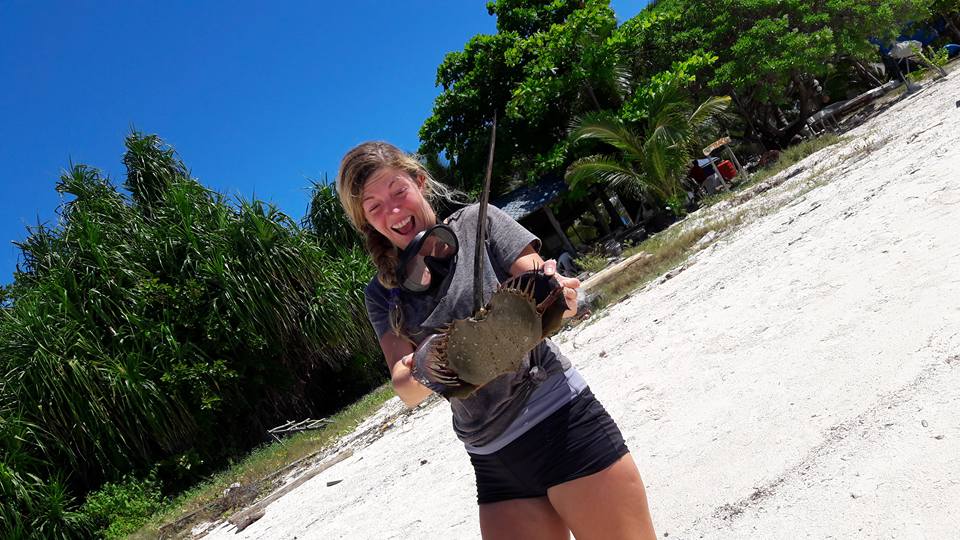
Horse Shoe Crab Release


A short stop in Lahad Datu for breakfast around 6am today turned into another Marine-life Rescue Mission for TRACC. Two Pala'u ladies arrived at the morning market with 3 horseshoe crabs. Both of them hardly speak any Malay so couldn't find out the exact location where they caught these pre-historic looking creatures. 
Anyway, bought all 3 horseshoe crabs and took them to Pom Pom island. I personally have only seen one here last year but we have seen many small ones in Kulapuan. Hope the release of one big female and two smaller males will bring back the population of horseshoe crabs around Pom Pom island. Our staff and volunteers were so excited to have this rare opportunity to handle these living fossils and releasing them back into the sea! - Gon

Horseshoe crabs are easy to catch and are often found in the fish market. They don't have any "meat" to speak of and taste a bit like fresh seaweed (salty, rubbery, cold and disgusting).

Horseshoe Crabs are often called "living fossils". The earliest record of them is in the Ordovician period 450,000,000 years old and they haven't changed much since.

They're more closely related to spiders than crabs but have 10 legs rather than 8 and external gills like a prawn.

They also have a peculiar number of "eyes". There are two compound eyes where you might expect them to be, but then there are five additional "eyes" that have different resolutions and functions - two of them respond to visible light and three to ultraviolet. There are also light receptors along the tail that helps the Horseshoe synchronize its body clock with light and day. Finally, there are two ventral (on the underside) eyes near its mouth.

25.10.16

Sabah Shark Protection Association (SSPA) Proposal


As part of my intern experiences, on the 16th of July, I was given a chance to take a further step deeper into my learning and be part of a proposal meeting by representing both TRACC and Shark Stewards.
 

The proposal meeting was held in Kota Kinabalu and the proposal was on protecting sharks and rays in Sabah. I am so grateful that I was given such a great opportunity by both Dr David McGuire, the founder of Shark Stewards and Prof. Steve Oakley of TRACC to participate and be involved in this pre-proposal meeting.
 

I was able to meet people from different organisation including WWF Malaysia, Scuba Zoo, LEAP, Scuba Junkie, MNS and MCS. Including TRACC and Shark Stewards, these eight non-profit organisations forms an association call Sabah Sharks Protection Association (SSPA) where they work together to protect sharks and rays in Sabah. I personally found my first experience of a pre-proposal meeting intense but by the end of the meeting, I felt thankful that I was able to be part of this proposal meeting. Not only did I get to meet different organisations that share the same goal and passion to protect sharks and rays in Sabah, I was involved in a proposal that we all hopes will have sharks and rays protected in Sabah. That in itself fills my hearts knowing that we are all trying to make a difference not just for the sharks or rays but for the whole world. 


All my intern experiences

 
(This blog is written by Natalie Chai)


If you want to help with any marine conservation activity, please check our website http://tracc.org or email info@tracc-borneo.org
For more updates on TRACC check out our Facebook, Twitter or Google+


If visits to Tracc are not possible then please help with financial support and follow our projects on facebook


20.9.16

Community Coral Planting on Kalapuan

The Community Coral Team 
A bustle of activity and a flurry of hands helped to build 12 bottle reefs and 2 big turtle reefs during the Community Coral Planting day on Kalapuan Island.

Upon arrival to Kalapuan, TRACC staff and volunteers were greeted from the shores by the usual picturesque scene of blue water, green trees, and smiling faces and happy hands. As an added bonus Chief Ibno organized a pre Community Coral Day beach clean, greeting TRACC with clean beaches and a successfully collected and pile of
plastic bottles, wrappers and polystyrene.

Nat and Christine Talking Shark Fin Soup
Between reef making and lunch eating, Liam, Khairul, Nat and Christine gave a talk about the importance of coral reefs and the role of sharks in coral reef ecology. Highlighting the importance of conserving the reef and saying no to shark fin soup.

Waving a temporary goodbye to Kalapuan as the boat departed at the end of a productive day the event felt like a great success. But the works not over yet, TRACC will organize another Community Coral Planting Day in the near future to drop the completed and dried reefs.


Bottle Reef Making with Wellman and Liam

A big thanks to Mr. Yusof owner of the Kalapuan Island Resort for the use of the resort and providing a location to drop the reefs, the volunteers from TRACC and Kalapuan, the TRACC staff for the months of planning and to the GEF Small Grants Program (SGP) for providing the financial support to make the Community Coral Planting day such a success!


---------------------------------------------------------------------------------------------------------------------------------------

If you want to help with any marine conservation activity please check out our website tracc.org or e-mail iinfo@tracc-borneo.org

For updates check out our facebooktwitter or Google +

Reef conservation would not be possible without the generous financial support from GEF/SPG for Malaysia who are helping our community activities, and coralreefcare.com who generously provide materials to build more reefs.   

If visits to Tracc are not possible then please help with financial support and follow our projects on facebook

5.9.16

Dive Instructor Vacancy

Tracc has a vacancy for a scuba instructor starting immediately.

We're a small, volunteer organisation that are restoring the reef around Pom Pom island in the Celebes Sea, off the East coast of Malaysian Borneo. See the Map.

We need our divers to be well trained; peak performance buoyancy is an integral part of everyone's open water course, because novice divers crash landing on our beautifully planted coral is just not an option. But, we don't have many students, just four or five a week, and we allow you two weeks per course so that you have plenty of time to do the job properly.


All this time means that there's plenty of opportunity for you to take part in the science and conservation aspect of the project too. Some of the diving we do is, well, unique....


For all the details, please send an e-mail to info@tracc-borneo.org 
or call Hazel on (+6) 019 8505412

24.8.16

Sunday Funday Backflips

It's not all work and no play! Sometimes Sunday-Funday means pleasure diving in new places. Sometimes it means doing backflips off the boat.


Sometimes it means making fun little videos.


Please wait for the video to load to check it out!


If you want to help with any marine conservation activity, please 
check our website http://tracc.org or e-mail info@tracc-borneo.org 

For more updates on TRACC check out our Facebook, Twitter or Google +


Reef conservation would not be possible without generous financial support from
GEF /SGP for Malaysia who are helping our community activities and coralreefcare.com who generously provided materials to build the new reefs.


If visits to Tracc are not possible then please help with financial support and follow their projects on Facebook.

10.8.16

Creature Feature - The Moray Eel

Photo by Basil Bohn
A constant creature of the TRACC house reef the moray eel is often hidden and often seen. Equipped with pharyngeal jaws, the moray is an imposing predator to the crustaceans, fish, and invertebrates that it seeks as a meal.  First it lays in wait, peeking its head from its burrow and sneakily scanning the reef. When spotted it strikes, grasping its prey whole and alive with its first set of outer jaws. Next, it extends its inner jaws, the pharyngeal jaws, to pull its prey down its throat and into its belly, still alive, still whole.


Yet, this beady eyed, and bead spotted eel is not at all harmful to humans, preferring to hide from their presence rather than be seen. The moray has also been observed to collaborate with one of its fellow reef dwellers - the coral grouper. Inhabiting different niches, burrows vs. open reef habitat, the coral grouper lives in the open reef water and has no access to the creatures that choose to hide in the crevices of coral, the grouper in turn struggles to catch creatures quickly darting to and fro. Thus this unlikely pair will sometimes team up, the grouper corralling creatures near the moray burrow, while the moray flushes creatures out of nooks and crevices of its home. Trapped from shelter on both sides, the creatures have no escape and the groupers and morays both get an easy meal.

Sometimes seen hidden in the cracks of the step reef, or twisted and wrapped around the nooks and crannies of the big brain corals scattered around Pom-Pom Island. The moray resembles a snake from the ages, an underwater serpent of the Slytherin, and something superb to be seen. 

========================================================================
If you want to help with any marine conservation activity, please 
check our website http://tracc.org or e-mail info@tracc-borneo.org 


For more updates on TRACC check out our Facebook, Twitter or Google +


Reef conservation would not be possible without generous financial support from
GEF /SGP for Malaysia who are helping our community activities and coralreefcare.com who generously provided materials to build the new reefs.


If visits to Tracc are not possible then please help with financial support and follow their projects on Facebook.

14.6.16

Leaving Pom Pom's Paradise

24 hours after waving goodbye to the glittery people and waters of Pom Pom Island and already I miss the ocean, the life, the people. Yes the short stint of air conditioning has healed the majority of my cuts, I’ve slept well pass the natural alarm clock marked by the end of fan time at 7:30AM, and have indulged in the luxury of restaurant quality food and choice. Yet, the lack of modern convenience, insect bites and salty showers is a tax I am more than willing to pay for the life of freedom, community, and awesome access to the ocean TRACC provides.

The short list of what my time on Pom Pom has meant to me is long. It includes– the faces of people laughing underwater – the bright blue gradients of ocean extending from the shore – grabbing a tank and diving at sunrise – feeling weightless – flooding my mask because I can stop smiling – eating bananas underwater – noticing something new about the ocean everyday – excited underwater screams – getting to know the resident creatures of the house reef – collecting and planting soft coral and hard coral, even when the current rips, it storms, and bringing baskets up and down is a chore – peanut butter kaya cracker time – underwater hammering – watching the artificial reef I have helped to build become populated with life – sand everywhere – feeling too hot – the freedom to engineer my own projects – holes in all of my perpetually dirty clothes – jetty time – tanned legs – wonderfully calloused and beat up feet – the stars – the bioluminescence – night diving and the whole other ocean scene that is illuminated under torch light – new favorite ocean creatures – hammock time – waking up to the sound of rain on my tent – learning something new so naturally everyday – the ragged pages of the ocean creatures book – big boat days – jumping off the jetty at Timba Timba – Rasma’s pumpkin curry – Lizz’s cakes – Gon’s roti – turtle walks – moon shadows – Sunday Fundays – Monday Dry Days (sometimes) – getting to know people I wouldn’t otherwise  – how the sun hits the water in the evening and the morning to give the surface a metallic sheen – beams of light breaking through the oceans surface – falling to the ocean floor from laughter – card games during safety stops – being directly involved in marine conservation –150 plus hours of accumulated underwater time – the community – the freedom to dive all the time – and being surrounded by passion and care for the ocean.

But most of all…. The People. The Diving. The Ocean.

Big love to all the many who made my time at TRACC what it was and all the enthusiasm and care for the ocean world.


--------------------------------------------------------------

If you want to help with any marine conservation activity, please 
check our website http://tracc.org or e-mail info@tracc-borneo.org 


For more updates on TRACC check out our Facebook, Twitter or Google +


Reef conservation would not be possible without generous financial support from
GEF /SGP for Malaysia who are helping our community activities and coralreefcare.com who generously provided materials to build the new reefs.

If visits to Tracc are not possible then please help with financial support and follow their projects on Facebook.


1.6.16

Coral Growth on the Bottle Reef

February 2016
Photo by Basil Bohn
Corals are the oldest animals on the ocean scene; some species have been studied to live 4,000 plus years.[1] Coral life begins as a free-swimming planula larva, who is carried by the ocean currents and drifts until it finds a suitable hard surface on which to attach. After successful attachment, if they are left undisturbed and ocean conditions are right, the coral will began to build a coral colony – secreting calcium carbonate into a wild mansion of natural architectural genius which can hold thousands of coral polyps in its rooms. In an ensuing symbiotic relationship, photosynthetic zooxanthellae algae will coat the surface of the coral colonies

Of the over 25,000 species of coral, 800 are hard coral. Slow growing and complex in their lifecycle, hard corals grow anywhere in between 5mm and 20cm a year. Out of these 800 plus species, about 250 are from the branching coral family of Acropora – a lovely family which displays their unique differences both boldly through
May 2016
Photo by Basil Bohn
bright colored tips and polyps, and subtly through slight slants of polyp bunching and pattern differences.

The TRACC ribbon reef is planted with a variety of these subtly distinctive Acropora corals.  Such as the Acropora parilis, the blue tipped and branching hard coral photographed here in February and again in early May. The growth and successful attachment is pleasantly and gratifyingly visible in the less than 3 month span of the two photos.

However, ocean lovers, divers and boat drivers beware – when trying to photograph again this week, we found our lovely coral animal in two. Saddened by the sight and the possibilities of lost life, I’ll be sure to be extra careful of the tread of my footsteps and the flap of my fins.

Growth of Acropora Coral Shown Through Overlay of Photos
Photo by Basil Bohn


--------------------------------------------------------------

If you want to help with any marine conservation activity, please 
check our website http://tracc.org or e-mail info@tracc-borneo.org 


For more updates on TRACC check out our Facebook, Twitter or Google +


Reef conservation would not be possible without generous financial support from
GEF /SGP for Malaysia who are helping our community activities and coralreefcare.com who generously provided materials to build the new reefs.

If visits to Tracc are not possible then please help with financial support and follow their projects on Facebook.