Showing posts with label #pompom. Show all posts

19.12.16

Social Media Volunteer


Kia ora! Hello! Hai!

Maddy here, I am a social media volunteer at TRACC- here until the end of January to share with you what the TRACC experience is all about. Every few days I will be posting up interviews with people at TRACC, explanations about what we have been up to during the week and lots of photos!

About me:

I am a 23 year old kiwi from a little place called Nelson. I grew up loving the water- spoilt for choice in New Zealand. I spent the past five years studying at Otago University and decided that at the end of it I wanted to take a break, to challenge myself and to see a bit more of the world. I came across TRACC while searching the internet for dive volunteer opportunities. I got my open water dive licence in 2014 in Nicaragua- it was here that my eyes were opened to the incredible world that lives in our oceans. My first time diving brings back childish feelings of new discovery, of feeling like a true alien in an environment so different from our on shore world. Diving also made me recognise that there is so much vulnerable life beneath our waters that deserve protection. Being in a privileged position to be able to observe the underwater world brought to me a sense of responsibility. This was always niggling in the back of my mind throughout my studies, but I had little opportunity to get out and dive. TRACC offered to me a way to learn more about the oceans and to be proactive in their protection. I signed up as soon as I found it.


The arrival

After spending 1 week on peninsula Malaysia enjoying the sights and sounds (and food!) I took an early morning flight from KL to Tawau. I arrived at the small airport to be met by TRACCs "fixer guy", Ujang, who introduced me to three other volunteers before putting us in a shuttle headed for Semporna. We arrived in the bustling seaside town of Semporna and were dropped at the tourist jetty. We met a couple of TRACCs long term volunteers and then waited a couple of hours while the shopping was finished and the boat was loaded up.

The boat trip was spent observing beautiful surrounding islands, stilt house villages and flying fish, enjoying the breeze, and trying to figure out which island was PomPom! After about an hour we arrived in paradise. I had seen photographs, but in the early evening light PomPom exceeded my expectations. White sand beach, crystal blue water, and a rustic wooden jetty leading up to my new home. We were warmly greeted by the other volunteers and given a tour of the site- the classroom, the communal dining/living area, the kitchen, the longhouse, the bathrooms, and the tents.   I put my bag down in my tent (surprisingly spacious, with a bed, power and a fan!) and already felt at home.

We had a delicious meal together (see the picture!). After a round of introductions we were then given an induction by the science interns aboutTRACC, how it operates, and what we could look forward to seeing in the water. We sat around chatting a bit longer before I took myself to my tent- knackered and content.


23.11.16

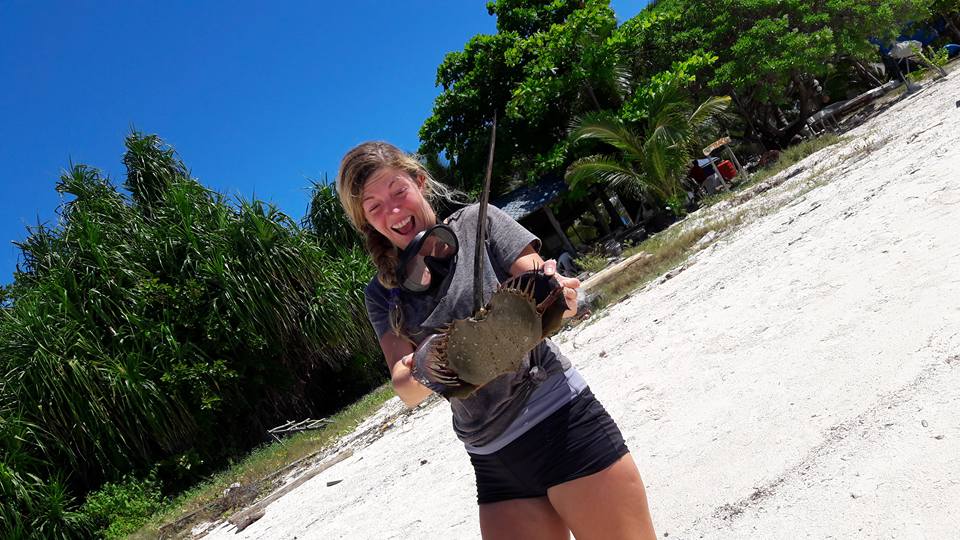
Horse Shoe Crab Release


A short stop in Lahad Datu for breakfast around 6am today turned into another Marine-life Rescue Mission for TRACC. Two Pala'u ladies arrived at the morning market with 3 horseshoe crabs. Both of them hardly speak any Malay so couldn't find out the exact location where they caught these pre-historic looking creatures. 
Anyway, bought all 3 horseshoe crabs and took them to Pom Pom island. I personally have only seen one here last year but we have seen many small ones in Kulapuan. Hope the release of one big female and two smaller males will bring back the population of horseshoe crabs around Pom Pom island. Our staff and volunteers were so excited to have this rare opportunity to handle these living fossils and releasing them back into the sea! - Gon

Horseshoe crabs are easy to catch and are often found in the fish market. They don't have any "meat" to speak of and taste a bit like fresh seaweed (salty, rubbery, cold and disgusting).

Horseshoe Crabs are often called "living fossils". The earliest record of them is in the Ordovician period 450,000,000 years old and they haven't changed much since.

They're more closely related to spiders than crabs but have 10 legs rather than 8 and external gills like a prawn.

They also have a peculiar number of "eyes". There are two compound eyes where you might expect them to be, but then there are five additional "eyes" that have different resolutions and functions - two of them respond to visible light and three to ultraviolet. There are also light receptors along the tail that helps the Horseshoe synchronize its body clock with light and day. Finally, there are two ventral (on the underside) eyes near its mouth.

10.9.16

A-Level All Stars 2016


The Classroom 
Only A*, A’s and B’s for the 2016 A-level class of TRACC! The many hours spent learning and teaching inside the stilted and turtle adorned classroom, studying on the jetty, the hammocks, number 4, and wherever else the class could find a quiet spot and a moment to resist the lure of the ocean has paid off.

The scores are awesome, but more so is the knowledge the class gleaned and shared. Simply by cohabiting the camp with an emphasis and atmosphere of learning and teaching, and plentiful knowledgeable people, the whole camp
Ocean Acidification Experiment
with Sophie and Basil 
became a little more tuned to the science of the ocean.


Congratulations all you fantastic A-levelers – Christine, Sophia, Peng, Sophie, Graeme, Basil, Oliver, and Tom Tom! And to all the wonderful teachers that helped them along – Tom, Steve, and Hazel!

For more info on the course please email info@tracc-borneo.org or visit the the website


--------------------------------------------------------------------------------------------------------------------------

If you want to help with any marine conservation activity please check out our website tracc.org or e-mail info@tracc-borneo.org

For updates check out our facebook, twitter or Google +

Reef conservation would not be possible without the generous financial support from GEF/SPG for Malaysia who are helping our community activities, and coralreefcare.com who generously provide materials to build more reefs.   

If visits to Tracc are not possible then please help with financial support and follow our projects on facebook