Showing posts with label marine science. Show all posts

23.12.16

Reef Check Malaysia


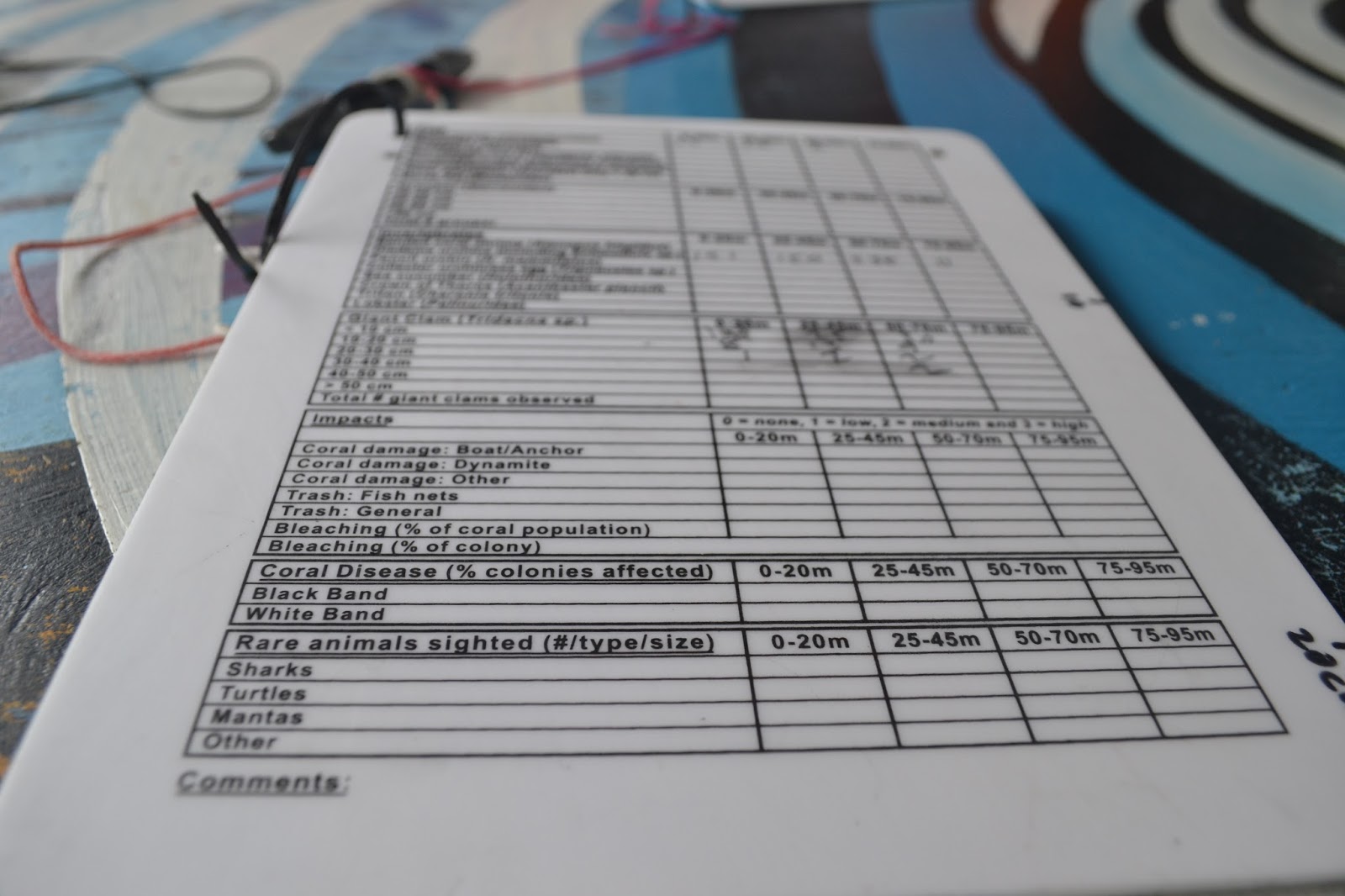
Earlier this month we were lucky enough to have Alvin from Reef  Check Malaysia join us for 3 days of training with our science team to enable them to conduct reef check surveys on Pom Pom Island. I sat down with him to talk about Reef Check and the valuable work they do.


What is Reef Check?

Reef Check's core programme is basically monitoring the health of reefs around the world. Its head office in California and there are 92 different offices around the world.

In Malaysia we have gone a bit further than just monitoring reefs. We had the data, then asked ourselves- what are we going to do about it? We have been closely involved with the local communities close to the reefs.We operate education programmes in schools, and offer building resilience programmes by identifying threats to the reefs and trying to find solutions. Examples of threats include trash, tourism and lack of education. To target these on Tioman Island (where Alvin is based) we have done a range of things. For example there was no recycling for an island of about 3800 people, with 60 resorts. Trash was just being stacked in one village then sent on a barge to the mainland. The barge was like Hansel and Gretel- dropping bits of trash all the way back. so we set up recycling so we can send out plastic and cans. Paper is still an issue as it has to be dry and it costs a lot t recycle. Glass is an issue too- as it is cheaper to make new glass than recycle old ones. And set up better sewage on the island, when before then there was nothing.

Tourism is another issue, with bad snorkeling and diving habits. People standing on the coral and breaking it. The Malay word for coral is actually very confusing. It means rock. so many people do not see coral as an animal- they see it as a rock so it is ok to step on.

Another programme we have is training up locals to work in the dive shops and resorts. Owners prefer to hire westerners and mainland people, which is stupid, because the locals know the area, the marine life and know how to find the good sites. Reef Check funds local dive master training and link people up with jobs. Next year we are introducing a course together with a university to train locals in the hospitality industry, so that they have a qualification and are more employable in the resorts. It is all a big task and habits are hard to change. The good thing is that we are seeing change.

We have corporate sponsors and a little bit of government funding at the moment, but it will only last us another 2 years so we are currently looking for more sponsorship. It is hard to make our work sexy, to attract sponsorship, as people often want to make tangible things such as coral replanting- but Tioman has really good coral- the need is more in community education and training.

How did you come to work at reef check?
I currently manage the programme on Tioman Island. I started diving in high school, which got me interested in marine science. I did my degree in marine science, then continued my masters. At the time I was volunteering for Reef Check. after i finished my masters a job popped up in KL. I worked there until we expanded to Tioman three years ago.

What is the training you have been conducting with our science team?
I was doing the EcoDiver course. Basically this is teaching volunteers how to do the reef check survey. One of the biggest problems in collecting data is that we never have enough marine scientists around, especially in Malaysia. Reef Check was designed to use your average diver with good buoyancy skills and train them about how to identify things in the sub-straight so they can conduct surveys and collect data. The information Reef Check gathers is accessible by anybody that asks- universities, government departments. We use the information to lobby governments to protect marine areas.

How many volunteers and dive sites does Reef Check have in Malaysia?

In Malaysia there have been about 500 divers trained. Out of those 500 divers we probably have about 50 active volunteers.
We have about 200 sites around the country. Every year we will organise to go to each of these sites and then come out with a calendar where volunteers can sign up to conduct surveys. Very seldom do volunteers go out on their own and send data. This will only happen with organisations like TRACC.

Alvin teaching our science team 
A reef check survey


Trained EcoDivers!

Thank you Alvin for bringing your valuable knowledge and training to TRACC!

5.11.16

Best marine science student in the world - 2nd year running.

The best marine science student in the world second year running, 2015 and 2016.
Well Done Christine (2016) and Tom (2015)  :-) :-)

best marine science student in the world
Classroom with a view. And excellent place to study.


TRACC teaching has recieved the fantastic news that for the second year, we have beaten all other students across the world to achieve the honour of highest scoring Cambridge Examinations Marine Science student in 2016.

The rest of the ALL STAR students in 2016 also did really well with only A*, A’s and B’s.

In 2015, we also manged the best marine science student in the world plus great results all round

Do you need great results to help get into University? Gap year or year out with a qualification!  Do you want to be a better Scuba divemaster or Instructor? Get more knowledge about the ocean through a professional, internationally recognized, Marine Science Course.
 
Why do we get good grades -  TRACC only offers one A level, Cambridge Marine science 9693 and we get excellent results.
Our record for A grades is 75%.  That's a whole lot of UKAS points if you want to get into uni, or its a good step towards your first year at college.

Scuba diving & Marine science lessons on a beautiful tropical island can get you a real internationally recognised Pre U qualification in a 14 week period of 2017.  The A level starts mid Jan 2017 and ends with the exams in late April.

For more info@tracc-borneo.org
http://tracc.org/marine-science-course-a-level-9693/

More blogs on Marine science class 2016

10.9.16

A-Level All Stars 2016


The Classroom 
Only A*, A’s and B’s for the 2016 A-level class of TRACC! The many hours spent learning and teaching inside the stilted and turtle adorned classroom, studying on the jetty, the hammocks, number 4, and wherever else the class could find a quiet spot and a moment to resist the lure of the ocean has paid off.

The scores are awesome, but more so is the knowledge the class gleaned and shared. Simply by cohabiting the camp with an emphasis and atmosphere of learning and teaching, and plentiful knowledgeable people, the whole camp
Ocean Acidification Experiment
with Sophie and Basil 
became a little more tuned to the science of the ocean.


Congratulations all you fantastic A-levelers – Christine, Sophia, Peng, Sophie, Graeme, Basil, Oliver, and Tom Tom! And to all the wonderful teachers that helped them along – Tom, Steve, and Hazel!

For more info on the course please email info@tracc-borneo.org or visit the the website! 


--------------------------------------------------------------------------------------------------------------------------

If you want to help with any marine conservation activity please check out our website tracc.org or e-mail info@tracc-borneo.org

For updates check out our facebook, twitter or Google +

Reef conservation would not be possible without the generous financial support from GEF/SPG for Malaysia who are helping our community activities, and coralreefcare.com who generously provide materials to build more reefs.   

If visits to Tracc are not possible then please help with financial support and follow our projects on facebook

26.8.16

ICOSMAP conference


This week two TRACC scientists, Thomas Gibson and Kit Wui Sien, went to the


International Conference of Oceanography & Sustainable Marine Production (ICOSMaP) 2016

This was hosted by the Marine Science Department at the International Islamic University Malaysia (IIUM) in Kuantan, Pahang, from 23rd to 26th August 2016.

Kit presented his work on step-reef construction techniques and Tom described recruitment to new reefs.
Tracc also showcased our data on the Mabul Shark Fishery (2014)(PDF)
and the Community Coral Planting project (2014-16)(PDF) which is funded by the GEF Small Grants Programme (GEF SGP) implemented by UNDP.

Link here to the abstracts, the posters and the manuscripts.


++++++++++++++++++++++++++++++++++++++


If you want to help with any marine conservation activity, please 
check our website http://tracc.org or e-mail info@tracc-borneo.org 
For more updates on TRACC check out our Facebook, Twitter or Google +

TRACC has opportunities for scientists, media or social science students


Reef conservation would not be possible without generous financial support from
GEF /SGP for Malaysia who are helping our community activities and coralreefcare.com who generously provided materials to build the new reefs.


If visits to Tracc are not possible then please consider financial support and follow our projects on Facebook.


11.8.16

Fantastic 2016 marine science A level results.

Tracc are very proud to announce our 2016 A-level results! 3 A*, 2 A and 3 B!! All our candidates worked exceptionally hard and should be very pleased with themselves. We certainly are. Well Done Everyone!!
 
 More info on the course and how we have achieved amazing results for several years. 

marine-science-course-a-level-9693

Photos of  the practical classes,


------------------------------


If you want to help with any marine conservation activity, please 
check our website http://tracc.org or e-mail info@tracc-borneo.org 


For more updates on TRACC check out our Facebook, Twitter or Google +


Reef conservation would not be possible without generous financial support from
GEF /SGP for Malaysia who are helping our community activities and coralreefcare.com who generously provided materials to build the new reefs.


If visits to Tracc are not possible then please help with financial support and follow their projects on Facebook.

6.4.16

A-level Experiments

In recent weeks, the A-level students have been conducting their own experiments using the reefs and ecosystems on our doorstep to further their understanding of the course material.

Ocean Acidification

To demonstrate and understand the possible effect of ocean acidification on corals and their calcium carbonate skeletons, the students designed a lab experiment to see exactly how acid affects coral.
Tom's acidic solutions and test coral fragments

The students prepared solutions with different levels of acidity and exposed pieces of dead coral fragment to each solution to simulate the effect that an increasing level of ocean acidity would have on live corals.

The students found that the more acidic the solution, the more mass the dead coral fragments lost. This was due to the calcium carbonate structure of the dead corals being dissolved into salt, water and carbon dioxide by the acid present in the solutions
Christine measuring mass loss

The results of the experiment were sobering and illustrated the potential devastating effect that ocean acidification may have on coral reef ecosystems around the world.


Plant Physiology: Photosynthetic rate


Sophia collecting produced 
oxygen for measuring
To demonstrate and understand the different factors which affect primary producers and their rate of photosynthesis, the students designed a natural experiment to see how light intensity affects the rate of photosynthesis of sea grass.

Graeme checking his experimental
set up
The students used oxygen production of the sea grass (Thalassia sp.) in our lagoon for a proxy of photosynthetic rate. By comparing the light intensity throughout the day and measuring oxygen production at specific intervals, the students found that light intensity has a great impact on photosynthetic rate. The students found that more oxygen was being produced when the sun was stronger, confirming their hypothesis.
Home-made oxygen capture kit

23.3.16

Bycatch smells!

The real problem of bycatch is the smell of rotten fish.

The tracc marine science alevel class watched the landing of 137 fish boxes or over 4000 kg of decomposed  bycatch.  These small fish crabs rays should have grown into adults in a sustainable #fisheries instead of being trash destined only for fishmeal at less than 10 cents US$ per kilo.
At kota kinabalu sabah malaysia

13.3.16

Artificial Reefs Part 1 - Building New Habitats and Homes

Bottle Reefs Drying in the Sand and Sun


Days at TRACC are filled with work dives, fun dives, classes, reading, species identification, and the inevitable hammock time in the heat of the day to recover brainpower and refresh the senses. A few times a week, once the heat of the day has diminished, the evening is filled with the communal labor of creating artificial reefs. The steady sound of the gaping mouth of the cement mixer turning and churning is the background to this labor, and the majority of camp contributes as much as they can. 

Some volunteers peel labels off glass bottles and cut twine for handles; others dig holes in the sand and cut corners out of cardboard boxes to create frames for bottle reefs. Still others bend PVC piping and ball netting for a different type of reef or scour camp for useable material and housing for sea creatures, asking, “If you were a fish would you live in this?” Then, the cement gets poured and the reefs are left to dry.

All artificial reefs built at TRACC are created with a specific biological niche in mind; for bottle reefs it is often the shallow reef crest. After the cement dries, the bottle reefs are placed throughout the various depleted reefs around Pom Pom Island, and in a twisted and spiny line along the reef crest just outside of TRACC. Once placed, we plant them with collected broken coral which immediately attracts a rainbow of little fishes and crustaceans who come to check out a new coral home.  


Sophie and Sophie Cleaning Bottles


A little farther down the slope, nets are draped and planted with the gentle pastels and sways of soft corals steadily in motion like pulsating flowers in their filtering and feeding, and are already being utilized by the sandy brown speckled moray eel that one must be careful to avoid when planting with coral. 


Bottle reefs are tipped upside down and sunk as to create steps and niches at slightly different depths to attract a greater diversity of species. Plastic crates combined and submerged to create the aptly named “biodiversity reefs” – attract a great variety of magnificent sea life, ranging from large brown and black spotted sweetlips hiding in the shadows, to cute little candy crabs nestled in the nephtheidae soft coral reaching its pink broccoliesque arms towards to light, and a whole spectrum of brightly colored fish, crustaceans, and corals, as well passing fantastical visitors like the grumpy frogfish.

Borja Helping to Build the Bottle Reef


Still more artificial reefs are created as by pouring cement into flat circular “biscuits” with holes poked into them for coral planting in the shallows to be utilized as nurseries for creatures and coral alike. 

At greater depths PVC pipes bent into igloos, tipis, and a swim through gather algae and coral on their surface to create space for sea creatures seeking refuge from predators. Tires sunk at an even greater depth are planted with deep water gorgonian coral and black coral, which are beginning to spread their deep purple fans ever wider and spiral ever farther upwards. These deep-water structures are often inhabited by octopus and other burrow loving creatures slinking back into the crevices of empty tire tubing.


It is so satisfying to participate in the whole process of the artificial reefs – the making, the placing, the planting the corals, and the intense satisfaction of seeing them populated by creatures in what was once a depleted reef of mainly coral rubble.  

More Marine conservation projects

Reef conservation would not be possible without generous financial support from
GEF /SGP for Malaysia who are helping our community activities.

Coralreefcare.com
If visits to Tracc are not possible then please help with financial support and follow their projects on Facebook.  https://m.facebook.com/Coral-Reef-Care-106658702743344/


--------------------------------------------------------------
If you want to help with any marine conservation activity, please
check our website or e-mail info@tracc-borneo.org
The main website is at http://tracc.org
Check out our posts on our activities
on fb tracc.borneo
on twitter tracc_borneo
on google + tracc

2.2.16

Coral identification

The easist corals to study are in the lagoon and
are very shallow at low tide.  However even with the books
and easy access it is hard to identify hard corals to family
and we can identify very few to species.   YET :-)


More blogs on Marine science class 2016
More info on the Cambridge Marine science A level class


Become a volunteer in 2016 here

Conservation projects 2016

For more information, please check our website or e-mail info@tracc-borneo.org 


The main website is at tracc.org
Check out our social media posts on our activities
on fb tracc.borneo
on twitter tracc_borneo
on google + tracc 
Instagram  traccborneo