Showing posts with label alevel. Show all posts

5.11.16

Best marine science student in the world - 2nd year running.

The best marine science student in the world second year running, 2015 and 2016.
Well Done Christine (2016) and Tom (2015)  :-) :-)

best marine science student in the world
Classroom with a view. And excellent place to study.


TRACC teaching has recieved the fantastic news that for the second year, we have beaten all other students across the world to achieve the honour of highest scoring Cambridge Examinations Marine Science student in 2016.

The rest of the ALL STAR students in 2016 also did really well with only A*, A’s and B’s.

In 2015, we also manged the best marine science student in the world plus great results all round

Do you need great results to help get into University? Gap year or year out with a qualification!  Do you want to be a better Scuba divemaster or Instructor? Get more knowledge about the ocean through a professional, internationally recognized, Marine Science Course.
 
Why do we get good grades -  TRACC only offers one A level, Cambridge Marine science 9693 and we get excellent results.
Our record for A grades is 75%.  That's a whole lot of UKAS points if you want to get into uni, or its a good step towards your first year at college.

Scuba diving & Marine science lessons on a beautiful tropical island can get you a real internationally recognised Pre U qualification in a 14 week period of 2017.  The A level starts mid Jan 2017 and ends with the exams in late April.

For more info@tracc-borneo.org
http://tracc.org/marine-science-course-a-level-9693/

More blogs on Marine science class 2016

10.9.16

A-Level All Stars 2016


The Classroom 
Only A*, A’s and B’s for the 2016 A-level class of TRACC! The many hours spent learning and teaching inside the stilted and turtle adorned classroom, studying on the jetty, the hammocks, number 4, and wherever else the class could find a quiet spot and a moment to resist the lure of the ocean has paid off.

The scores are awesome, but more so is the knowledge the class gleaned and shared. Simply by cohabiting the camp with an emphasis and atmosphere of learning and teaching, and plentiful knowledgeable people, the whole camp
Ocean Acidification Experiment
with Sophie and Basil 
became a little more tuned to the science of the ocean.


Congratulations all you fantastic A-levelers – Christine, Sophia, Peng, Sophie, Graeme, Basil, Oliver, and Tom Tom! And to all the wonderful teachers that helped them along – Tom, Steve, and Hazel!

For more info on the course please email info@tracc-borneo.org or visit the the website! 


--------------------------------------------------------------------------------------------------------------------------

If you want to help with any marine conservation activity please check out our website tracc.org or e-mail info@tracc-borneo.org

For updates check out our facebook, twitter or Google +

Reef conservation would not be possible without the generous financial support from GEF/SPG for Malaysia who are helping our community activities, and coralreefcare.com who generously provide materials to build more reefs.   

If visits to Tracc are not possible then please help with financial support and follow our projects on facebook

11.8.16

Fantastic 2016 marine science A level results.

Tracc are very proud to announce our 2016 A-level results! 3 A*, 2 A and 3 B!! All our candidates worked exceptionally hard and should be very pleased with themselves. We certainly are. Well Done Everyone!!
 
 More info on the course and how we have achieved amazing results for several years. 

marine-science-course-a-level-9693

Photos of  the practical classes,


------------------------------


If you want to help with any marine conservation activity, please 
check our website http://tracc.org or e-mail info@tracc-borneo.org 


For more updates on TRACC check out our Facebook, Twitter or Google +


Reef conservation would not be possible without generous financial support from
GEF /SGP for Malaysia who are helping our community activities and coralreefcare.com who generously provided materials to build the new reefs.


If visits to Tracc are not possible then please help with financial support and follow their projects on Facebook.

6.4.16

A-level Experiments

In recent weeks, the A-level students have been conducting their own experiments using the reefs and ecosystems on our doorstep to further their understanding of the course material.

Ocean Acidification

To demonstrate and understand the possible effect of ocean acidification on corals and their calcium carbonate skeletons, the students designed a lab experiment to see exactly how acid affects coral.
Tom's acidic solutions and test coral fragments

The students prepared solutions with different levels of acidity and exposed pieces of dead coral fragment to each solution to simulate the effect that an increasing level of ocean acidity would have on live corals.

The students found that the more acidic the solution, the more mass the dead coral fragments lost. This was due to the calcium carbonate structure of the dead corals being dissolved into salt, water and carbon dioxide by the acid present in the solutions
Christine measuring mass loss

The results of the experiment were sobering and illustrated the potential devastating effect that ocean acidification may have on coral reef ecosystems around the world.


Plant Physiology: Photosynthetic rate


Sophia collecting produced 
oxygen for measuring
To demonstrate and understand the different factors which affect primary producers and their rate of photosynthesis, the students designed a natural experiment to see how light intensity affects the rate of photosynthesis of sea grass.

Graeme checking his experimental
set up
The students used oxygen production of the sea grass (Thalassia sp.) in our lagoon for a proxy of photosynthetic rate. By comparing the light intensity throughout the day and measuring oxygen production at specific intervals, the students found that light intensity has a great impact on photosynthetic rate. The students found that more oxygen was being produced when the sun was stronger, confirming their hypothesis.
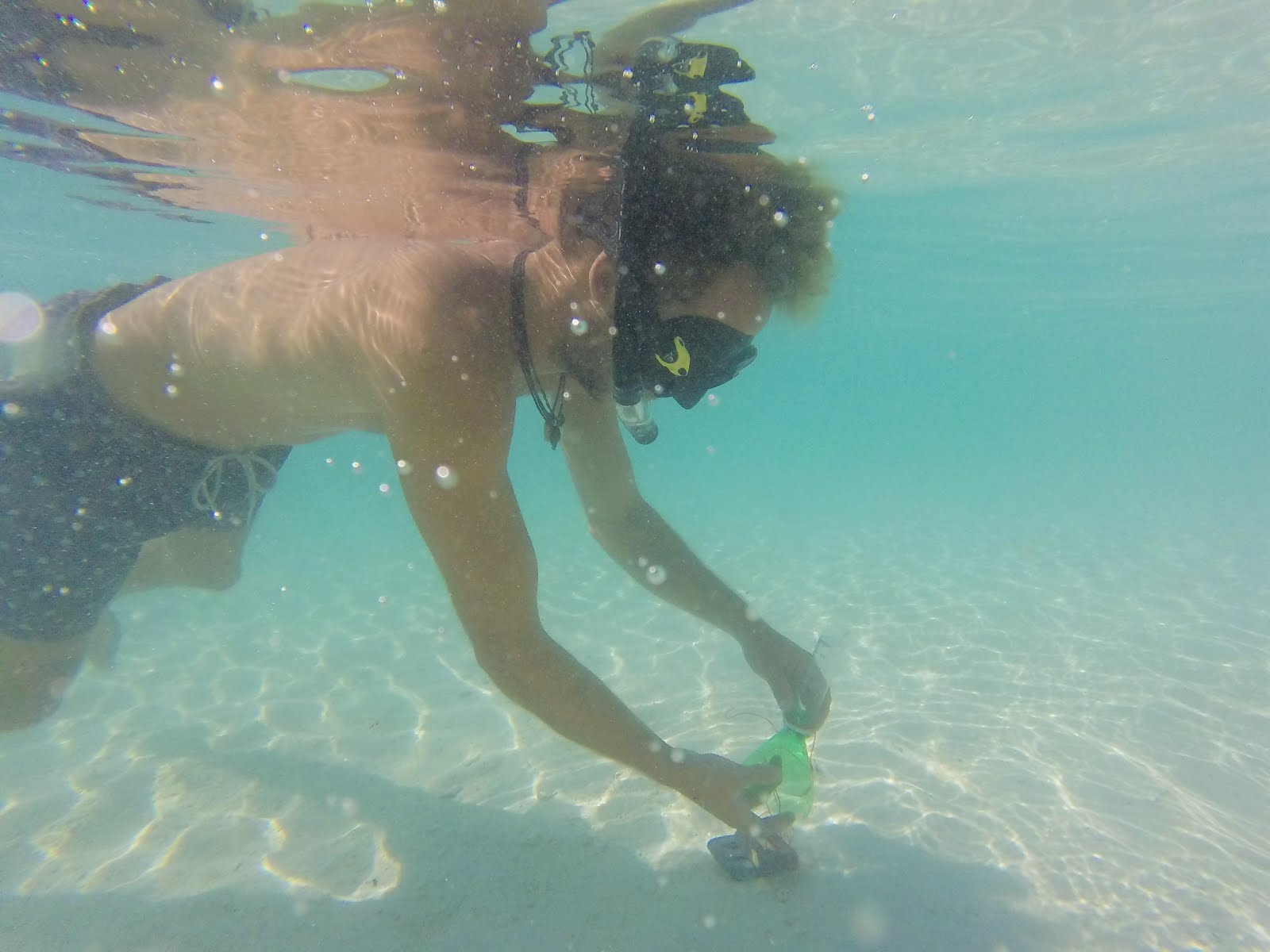
Home-made oxygen capture kit

23.3.16

Bycatch smells!

The real problem of bycatch is the smell of rotten fish.

The tracc marine science alevel class watched the landing of 137 fish boxes or over 4000 kg of decomposed  bycatch.  These small fish crabs rays should have grown into adults in a sustainable #fisheries instead of being trash destined only for fishmeal at less than 10 cents US$ per kilo.
At kota kinabalu sabah malaysia

20.8.15

I got A* in Marine Science

Why Do Marine Science A level with TRACC 


  • Learning on location – first hand experience of the curriculum rather than reading from a book
  • Experienced teaching staff
  • Great opportunity to learn more about the marine environment whilst helping out on a conservation project
  • Good fun – interactive and practical methods of learning makes learning easier
  • Class in the morning and diving in the afternoon


This year I studied for my Cambridge International 9693 Marine Science A-level at TRACC. The experience of studying at TRACC was great. Firstly, TRACC’s location is perfect for the course – instead of staying in a stuffy classroom and reading from a book, many of the topics in the course were covered with practicals and first-hand experience.

 To learn about mangroves we spent the morning canoeing through the dense mangroves a short distance down the shore from camp, looking out for macaques and monitor lizards as we paddled. To learn about rocky shore zonation and unstable beach environments, we stepped out of our open air sea view classroom and straight onto the beach for an interactive lesson. We spent the morning learning about fish physiology and in the afternoon we went diving to see examples of what we had covered. Fish dissections and fish market surveys all helped consolidate what we learnt in the classroom. By having practical experience right on the classroom doorstep, it made studying much more interactive and interesting.

The experienced teaching staff at TRACC were great and knew how to explain complicated concepts and theories simply. They were always on hand to help and to make studying easier. Completing a 2 year course in 3 months may seem intimidating at first, but with TRACC’s staff full time support this was definitely doable and gave us plenty of time to enjoy ourselves whilst at it.

Studying fringing reefs from the top of a sinking volcano
makes the theory so much more understandable.
Marine science is an interdisciplinary science and this really shows in the curriculum. Topics range from plate tectonics to aquaculture to ecology and this keeps the course interesting and fresh from start to finish. The course goes hand-in-hand with diving and marine conservation - the amount I now know about the world around me while diving has increased dramatically. I’d recommend the course to all divers and volunteers who want to work with the ocean, gain an A level during a gap year or become more knowledgeable divers.
Of course the Marine Science A level also helps understand why TRACC is conserving coral reefs whilst learning more about the environment they are helping to conserve and want to increase their knowledge of the marine world in general. 

I got an A*
 
Tom Class of 2015

31.5.15

Marine Science A Level at TRACC

Pom Pom Island is just magical
I have to start by saying it was with some trepidation that I decided to take part in the 2014 Marine science course at TRACC. Simply because it had been almost a decade since I had been at school studying. 

Within the first couple of weeks of classes, field trips and studying, my concerns had been replaced with excitement and curiosity. It is after all hard to be stressed on a beautiful remote tropical Island. I can’t think of a more suitable and amazing place to learn about marine science and the wonders of the marine world than the spectacular Pom Pom Island, surrounded by crystal clear water and white sandy beaches. Not to mention an array of sea creatures that are mind blowing.
Blue ring Octopus are common

Nudibranchs are my favourite

 Not only was the content of the course incredibly interesting and well structured, the field trips we were lucky enough to be a part of were amazing adventures.


These field trips included a hike up an extinct volcano to learn about atoll formation, a trek through a muddy mangrove to collect sediment samples and a trip to the local fish markets and docs to better understand fisheries management. Although, best of all was the awesome diving!!! Being able to observe for ourselves, symbiotic behaviour, biodiversity, food webs and much more at Pom Pom’s amazing dive sites, was just incredible.


Not only was the content of the course incredibly interesting and well structured, the field trips we were lucky enough to be a part of were amazing adventures. These field trips included a hike up an extinct volcano to learn about atoll formation, a trek through a muddy mangrove to collect sediment samples and a trip to the local fish markets and docs to better understand fisheries management. Although, best of all was the awesome diving!!! Being able to observe for ourselves, symbiotic behaviour, biodiversity, food webs and much more at Pom Pom’s amazing dive sights, was just incredible.
Fishmarkets
Rocky shore studies
The subject which affected me the most was human impacts on the marine environment. It really takes someone studying the topic to some degree to properly realise the enormity of the impacts we as people have on the marine environment. As shocking and frankly overwhelming as the module is, (covering topics such as; global warming, pollution and ocean acidification), being able to learn about them at a marine conservation centre from people who are actively making a difference, makes you understand how important education is in the fight for a sustainable future on earth.
Snorkel or dive with endangered turtles gives a new meaning to the study of conservation.
By exam time in Kota Kinabalu I was feeling as confident as a person can be before exam time! I may have even left a couple of the exams smiling


All in all, I can honestly say not only was it an amazing experience but it ignited a passion in me and helped me gain confidence in my ability to return to studying even in my late 20’s after a long gap.

I GOT AN A ---  Wohoo

Flic - class of 2014

published on goabroad.com