Showing posts with label beautiful island. Show all posts

14.10.16

Funday at Matabuan

A healthy coral reef at Matabuan.

On Sundays, we normally take a day off from conservation work and go FUNdiving :-) I remember when we went to Matabuan as our fun day trip. The ride to Matabuan was rather rough as a storm has just hit. Thus, when we went down for a dive, the visibility was not as great. However, undeniably, the coral reef is so much more diverse and healthier compared to Pom Pom Island. Good job done by Sabah Parks (Mantabuan is in Tun Sakaran Park, and has a marine police presence.)

A green turtle swimming into the blue.
Divers showing off their flying kicks and back flips.
Other than admiring the beauty of the coral reef, one of the most memorial part of the dive in Matabuan was 
when we found a patch of sand at depth about 8 meters. What is more fun than to take off our fins and do flips and flying kicks? We spent a good time defying gravity and although we consumed a lot of our air, it was still unforgettable.


Lunch at Matabuan Island.
Hunger took over after that dive and so we had lunch on the island. We found a good spot with lots of shade, placed a tarp on the sand and settled down. We had some good discussion about what we saw during the dive and played a game of charades. After much laughter, it was time to head back to Pom Pom. Fun day to Matabuan was definitely a day we would never trade for any other days. The dive site, the company of these volunteers, the food, the view and everything else on top of that.

If you want to help with any marine conservation activity, please check our website http://tracc.org or email info@tracc-borneo.org
For more updates on TRACC check out our Facebook, Twitter or Google+


Reef conservation would not be possible without generous financial support from
GEF /SGP for Malaysia who are helping our community activities and coralreefcare.com who generously provided materials to build the new reefs.


If visits to Tracc are not possible then please help with financial support and follow their projects on Facebook.

25.2.16

Turtle Nesting on Pom Pom Island

The Return to the Ocean
This week, the first turtle of the season clambered onto the beach just outside of TRACC to lay her many eggs. As we sat in the communal area, number 4, waiting for dinner we were alerted to unusual activity by the steady bark of the camp dog Monsoon. Curious about the barking Paul went out to check out the scene, triumphantly returning with news of turtle tracks just up the beach. Equipped with red headlamps and the knowledge of Professor Steve, the camp went out to find a large, old and impressive green turtle well hidden beneath the spiky underbrush.

Turtles are aged through the length of the shell, with about 1-2 cm equaling 1 year, this one measuring 1 meter from shell tip to tip was a little less then 100 years old when accounting for her initial 2-4 cm hatchling shell.

Oblivious, as most sea creatures are to red and green light as they have no need to distinguish between it at the depths they spend most of their lives where those colors don’t reach, we watched her under the red glow of a headlamp. The initial hole was dug with the front flippers with much crashing of undergrowth. The next stage was chambering where she dug a smaller hole at the bottom of the pit.  Steadily she used one rear flipper then another rocking her body to and fro to dig her hole into the sand. She folded in the edges of her hind flippers to create a perfect bowl shaped shovel and continued the hard work of making a deeper nest. When she could no longer reach the bottom of her egg chamber, she moved to position her hind flippers over the hole.

Laying Eggs in the Underbrush
It’s usual for a turtle to lay between 80 and 100 eggs, 3-7 times each year and the range is thought to be between about 60 and 120. When satisfied with its size and depth, she began to lay her approximate 140 eggs in what we believe to be her first nest of the season.

After laying her eggs she filled her nest with sand to cover and incubate the eggs, and then tossed
sand and brush over the nest with her front flippers, to hide the nest. Becoming tired, she slowed more often to rest during this process, providing a chance for the A-level marine science students to practice some of their data collection skills and measure the turtles shell height and width – the standard measurements used to determine size and age. The resting period of our turtle friend also gave the team from Pom Pom resort, which has the official privilege to gather and safely incubate the eggs away from the danger of poachers and natural scavengers, a chance to begin collecting the eggs.

A-Level Students Basil and Graeme
Soon after she was satisfied her nest was safely hidden she turned around in the sandy underbrush, clumsy with her huge weight on land, and headed back to the ocean. Surprisingly quickly and steadily she made her way down the beach, shortened by the high tide she prefers for nesting, and entered to water.

Its easy to imagine she must now be relieved to be back in the ocean where her 100 Land kilograms are lightened to what feels like 2, and she can gracefully and swiftly move through her underwater home. In about 2 weeks she will pick another evening high tide to revisit the beach within about 50 meters of her first nest and lay another nest of eggs. For now, her eggs lay safely protected and incubating on Pom Pom Island, and in about 60 days we will have the privilege of witnessing the hatchlings finding their way back into their watery home.  

More about the turtles of Pom Pom

For more information, please check the TRACC website or e-mail info@tracc-borneo.org 


The main website is at tracc.org
Check out our social media posts on our activities
on fb tracc.borneo
on twitter tracc_borneo
on google + tracc 
Instagram  traccborneo


27.1.16

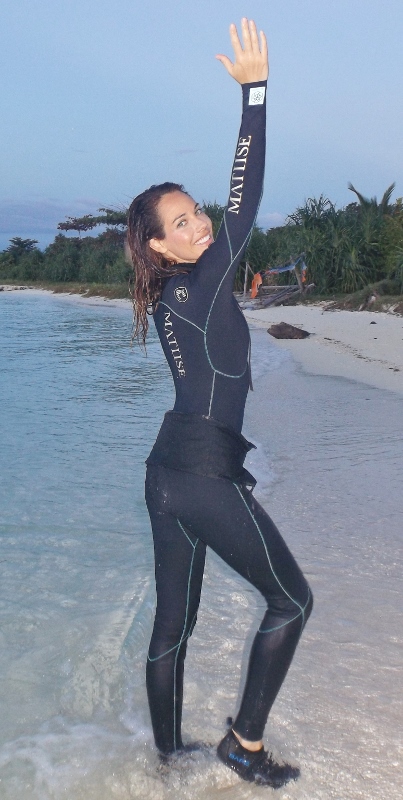
Wet suit model on Pom Pom Beach

wet suit model on beautiful beachAll beaches need more of these  :-) Beautiful ladies in the latest design of wetsuit.  Sun, Sea, Sand, Scuba complete with Marine conservation, awesome diving and models,  fantastic especially since the lady is also very talented and a committed conservationist.
wet suit model on beautiful beach


In November 2015 we were lucky enough to have a visit from Cynthia a keen enthusiastic Ocean saver from Texas USA,  She dived with TRACC to see how we conserve coral reefs, she planted corals and helped us with the biggestsharkinborneo.  We discussed tactics and explored ways to save the sharks, turtles and biodiversity of the planet.


 Become a volunteer in 2016 here

Rescued shark

Conservation projects 2016

For more information, please check our website or e-mail info@tracc-borneo.org 

wetsuit model on beach
The main website is at tracc.org
Check out our social media posts on our activities
on fb tracc.borneo
on twitter tracc_borneo
on google + tracc 
Instagram  traccborneo


PS, we can't always guarantee that there will be a model on the beach but we can guarantee awesome diving and snorkelling :-)

12.9.15

Ten facts to know about becoming a marine biologist

how to beome a marine biologist
Dive surveys
Ten facts you need to overcome to plan a career as a marine biologist. 
Start with more info - if you are still at school or pre U or working on a career change then a marine science course will help test your desires before you spend 3-4 years at Uni or college.

Becoming a marine biologist is fantastic in many ways but it is a hard choice.  Jobs are few.  From 10 people with PhD degrees only 1 will be working in their chosen field by the time they are 40 years old. Many more will work in the dive tourism industry.

Most marine biologists are part-time, they have careers in other fields. Sometimes teaching, sometimes aquaculture, sometimes fisheries, sometimes in aquariums. Not many get to be "Marine Biologists". The smartest people can work in Universities doing experiments, a few lucky people (like me) make marine biology part of another career (tourism management) and get to spend some days each month in the field.  To succeed you need brains, hardwork, determination and luck (IMHO).

1 Not all your work will be glamourous,  autopsy on turtles killed by plastic (conservation), measuring and gutting fish (fisheries) or working with sick, dying fish (aquaculture) will test your gag reflex and resolve.

measuring sharks
Measuring sharks
2 It is not well paid and the career prospects are low. Jobs are hard to find - start as an intern.  Biotechnology is a much better career choice or Fisheries or Aquaculture.

3 Lots of time is spent in the office writing reports, blogs or social media and lots more time is spent in meetings.

4 Studying, saving or simply managing any part of the planet is frustratingly slow, from species which need protection today to ecosystems that are changing slowly because of global climate change.

5 The weather is not always kind,  a beach survey in January at low tide (= dawn) anywhere in the world is hard but cold places have more jobs than warm places so chances are it will be snowing.

6 Do you get seasick?  Some of the best marine biologists avoid boats because of this. There are shore based jobs out there but there is more competition for jobs where you get to go home every day :-)

Pre dawn light on a rocky shore survey
7 Do you hate bugs?  From jellyfish and stonefish to mosquitos and ants there is always something trying to bite, sting or eat you.

8 Life on a tropical beach for months at a time when diving every day is hard on your body.  You need a strong immune system and a willingness to eat all the fruit and vegetables possible.  Finding enough protein as a vegetarian is extra hard so carnivores suffer less from infuriating illnesses.

9 Do you love study and reading.  The ocean is the underexplored 70% of the planet and we learn new things all the time.  Study and reading are part of the process.
10 Does a foreign culture excite you.  There are more jobs scattered around the world but to survive the culture shock you need to be able to accept hardship because chances are; that where-ever you get to work doesn't have familiar fast food or supermarkets.


Underwater work
If this has not put you off - the benefits to being a marine biologist are many.  Read what Natalie says about her Internship.
Read the 10 best reasons for studying marine science here.
or the 10 best ways to become a marine biologist here.
or How to get a job in Marine Conservation.

good luck
Lifting heavy objects - There are days when diving is just another job. 


For more information, please check our website or e-mail info@tracc-borneo.org

The main website is at http://tracc-borneo.org
Check out our posts on our activities
on fb tracc.borneo
on twitter tracc_borneo
on google + tracc

or simply #tracc or #traccblog on Google, Facebook, twitter or instagram


10.8.15

What the Turtle Volunteers have been up to

About 25% of TRACC volunteers from May-September come to monitor the turtle nesting. It isn't possible to dive all day and walk round the island all night so this program is specifically for people who want to do some conservation without the expense (in either money or energy) of diving and reef restoration. They walk quietly round our lovely little island in the silence of the night and then snorkel peacefully in the heat of the day.


The turtle volunteers are also conducting in-water turtle surveys to monitor the turtle population and activity around the island. We've found that the green turtles outnumber the hawksbills by 10:1, but that the population dynamic is different. The green turtles are transitory adults; spending their days sleeping and eating in the shallows, mating and nesting. The hawksbill turtles tend to be resident, active juveniles.

Once the female greens are ready, they haul themselves up the beach and wander round it (often for hours) trying to find the perfect place to lay their precious eggs. We don't have any photos of this because any sort of disturbance at this point will have them beating a hasty retreat. So our turtle volunteers sit in the dark waiting for the girl to be ready.

Finally, when everything is perfect she settles into a semi-trance and starts to lay her eggs. She lays anywhere from 30-150 eggs depending on her age and how long she's been holding them. Often a female will return to the beach and go through the nesting process two or three times before she's finished for the season.

At this point the volunteers get face down in the sand for the enviable privilege of catching turtle eggs straight out of the mother. The eggs are all collected carefully and transferred to the island hatchery where they are safe from human poachers. There are no natural predators of turtle eggs on the island and if it wasn't for poaching the nests could be safely left in situ to develop naturally.

Although turtles are totally protected species and there are stiff penalties for taking their eggs, the local stateless people have very few economic opportunities. The poaching of turtle eggs is a major source of revenue for them but a major threat to turtle conservation.

All credits to Wirginia Romanowicz-Basiak for the photos.

For more information, please check our website or e-mail info@tracc-borneo.org

The main website is at http://tracc-borneo.org
Check out our posts on our activities
on fb tracc.borneo
on twitter tracc_borneo
on google + tracc

or simply #tracc or #traccblog on Google, Facebook, twitter or instagram


14.7.15

Malaysian Interns 2015

Our 2015 Malaysian Interns are finally here!


Malaysian Universities require their students to do twelve weeks of Industrial Training as part of their degree course. This year our lucky interns are coming to us from both UMT and UMS and have backgrounds in Marine Science or Conservation Biology. They successfully beat the rush back in December and were undeterred by the challenging application process; Allen, Martinus, Nadia & Shaakirah have finally made it all the way to an exciting internship with TRACC on Pom Pom, Sabah, Malaysia.

They will learn to scuba dive and (once they get past blowing bubble rings for hours) how to get to work underwater. Cement mixing, concrete lifting and lowering, reef rebuilding and coral transferring are all part of the days work at TRACC. This is part of our major restoration work where we stop the decimated rubble reef from moving and plant healthy baby corals in stable conditions. These in turn grow, stabilize the rubble further and provide critical habitat for all the other denizens of the reef.


On top of this, they will be undertaking research rotations with our resident scientists on the long term projects TRACC has running. These include fish, coral and invertebrate identification to species (there are over 300 species of fish alone!). The coral garden identification and mapping project (the coral id book comes in 3 volumes!). Soft coral stabilization of steep, mobile, rubble substrates ("Perhaps we can use soft coral to "stitch" the reef back together so that it stops moving enough for us to replant it".). Turtle daily migration patterns (Seriously, where does George go every afternoon?).

Finally, they will be mixing with people from different places, ages, backgrounds, opinions and experiences and discussing and debating all the marine science, conservation, ecology, anthropology, sociology and politics that affect the marine environment. The critical thing that unites everyone at TRACC is a love of the ocean, a passion to preserve what we have and the dedication to restore what has been damaged.

Allen, Martinus, Nadia & Shaakirah have a unique opportunity to witness the problems and take part in the solutions for themselves before graduating as enthusiastic Malaysian Scientists.

Good Luck Guys!


For more information, please check our website or e-mail info@tracc-borneo.org

The main website is at http://tracc-borneo.org
Check out our posts on our activities
on fb tracc.borneo
on twitter tracc_borneo
on google + tracc

or simply #tracc or #traccblog on Google, Facebook, twitter or instagram


3.6.15

Exceptional diving with barracuda school on Pom Pom Island

School of Barracuda at Magic Rocks,
Pom Pom Island
The School of Barracuda at Magic Rocks, were just amazing,
The diving on Pom Pom Island over the past few weeks has been exceptional, with every single dive being a stand out. The marine biodiversity is truly amazing and the variety of diving that can be done here needs a solid mention as well.
Yeah man! 
It's gotten so much better here! 
Maori Wrasse and Giant groupers are around, saw an eagle Ray yesterday as well. 

Steve thinks the Mauri wrasse are the ones that TRACC rescued from fishermen in 2013 & 2014.
 
And then the macro life is as good as it always was!


Oscar
DM with TRACC - Tropical Research And Conservation Center
— at Pom Pom Island

More info about learning to dive or volunteering to help save the ocean with TRACC in Malaysia - Turtle Snorkellers - Divers 

Search #tracc 

Blog posts about TRACC 2015

Linda on Pom Pom Island
during a visit to TRACC volunteer camp
TRACC has been visited by some interesting bloggers who write stories about their travels and experiences as a diving volunteer.  These are a few blog posts that we have found and saved.

Linda and the people 


traccborneo-the-first-days

tracc-restoringcoralreefs

5-reasons-to-volunteer-at-tracc

Julia the wandering rain godess

Interview with Flick

Interview with Rachel

Sadie the eclectic traveller


Linda and Sadie

Eclectic traveller

A day in the life of a tracc volunteer

Rebuilding coral reefs

Photos to make you love Turtles.


More reviews about visiting TRACC and reviews about the Cambridge Examination Marine science A level.

More info about learning to dive or volunteering to help save the ocean with TRACC in Malaysia - Turtle Snorkellers - Divers 


29.5.15

Parrotfish survey at Magic Rock

Firstly let me apologize for the lack of parrotfish on these photos, they are not the easiest fish to photograph cause they are a bit shy and I am not the best of photographers yet.
But I did manage to capture thing for all you fish, nudi, inverts and turtle lovers.

Pom Pom is not only an abundance of fish, it's also a haven for all you seaslug, invert and nudibranch lovers out there.


More info about learning to dive or volunteering to help save the ocean with TRACC in Malaysia - Turtle Snorkellers - Divers 


27.5.15

butterfly fish survey

To survey the biodiversity of fish around Pom Pom we have started doing surveys by family since we have such an abundant of fish species.

First one to go was Butterfly fish, the survey was done at the Northern Tip divesite.

We not only saw a good diversity of Butterfly fish, species to be published later, we also saw a big school of about 20 bumphead parrotfish with a clown trigger fish in the middle of the school, and so many other beautiful ocean creatures.
Maria


More info about learning to dive or volunteering to help save the ocean with TRACC in Malaysia - Turtle Snorkellers - Divers 


22.5.15

Rescue diver, search pattern exercise

Today we had the search pattern exercise on land for our three rescue diver students.

Tomorrow we will have a rescue scenario underwater, photos of that to follow, so stay tuned...


More info about learning to dive or volunteering to help save the ocean with TRACC in Malaysia - Turtle Snorkellers - Divers